
Read along
The woman whose obituary I'd set came in at half past six. I asked whether she'd brought the receipt.
I'd taken her money for a room advertisement the week before, and I thought she wanted some of it back. That was where my mind went. I was fifty-one that October, with a sixth share in a South Shields weekly. That meant paying a sixth of the bill when the roof needed fixing. I had no say in who did the repairs or what they charged.
Ruth Mercer put a folded proof on the counter.
“There's been a bit of a rush,” she said. “I haven't finished with the house yet.”
Her notice gave Wednesday as the day of death. This was Thursday, in nineteen forty-eight, and Ruth had walked from the market carrying potatoes. Her son Arthur had supplied the copy. He'd said his mother was very poorly.
“I fainted,” Ruth said. “The doctor said I ought to eat before I started work. Apparently that wasn't worth putting in.”
She wanted to know whether the notice had been printed.
I explained that she was holding a proof, which was meant to catch mistakes before they reached the public. Having the deceased point them out was unusual, though I didn't say so. Ruth had a red mark across her palm from the shopping bag, and kept rubbing it while I spoke.
The composing room was behind the counter, through a door we generally left open. She followed me in while I checked the job book. Our notices occupied a narrow column beside the church announcements. The dates went in separately, often in whatever face we had enough of.
Her type had already gone into the proprietor's private hold box. He'd taken the key home. I crossed out the entry in the book and wrote “Cancelled” across her proof.
On the facing half of the folded sheet was a faint backward impression of her name. Somebody had folded it wet.
“They've done me twice,” Ruth said.
“Only charged once, I hope.”
That got a small laugh, and I was grateful for it. I wanted an ordinary customer again.
We telephoned Arthur at his office. He sounded embarrassed, which suited the explanation I'd already settled on.
“The date must have been misunderstood,” he said. “I'd asked about having something ready.”
“Your mother's here.”
“Yes, you've said.”
Ruth took the receiver before I could improve on that conversation. She told Arthur to come for his washing, and to bring back the key he'd borrowed for the furniture dealer.
Then she asked me to walk home with her.
“He'll tell me I agreed to things when I was poorly. You can hear me disagree while I'm well.”
I should have pulled the type before doing anything else. I could have fetched the proprietor's key or forced the box. Instead, I put my hat on. The entry was cancelled, the customer was satisfied, and I was already late for my tea.
Ruth's two lodgers worked at the docks. There was a smaller room she let when she could find somebody willing to sleep above the kitchen, where her day began at five.
“Arthur says I ought to give it up.”
“The early starts?”
“The paying customers. He doesn't mind me getting up to do his collars.”
She spoke without turning to see whether I'd appreciated it. I liked her company. We passed a fish shop with a queue outside, and she stopped to tell a woman that her missing basin was on the kitchen dresser.
Arthur was waiting outside the house. He shook my hand with both of his and thanked me for coming, though his mother had barely got her key into the door.
He was a clerk, with a clerk's concern for keeping his cuffs out of things. I had nothing against him then. An only son can become a nuisance when his mother is ill, and I'd known worse offences than arranging a notice too soon.
Ruth put the potatoes beside the kitchen range and pointed to an oak table.
“Thirty shillings,” she told me. “That's what his man offered.”
“I didn't accept it,” Arthur said.
“You hadn't anything to accept.”
He appealed to me with his eyebrows. I found a chair and made myself no help to him.
The cancelled proof lay on the table between us. Arthur read my writing, then asked whether I would be speaking to the proprietor.
“In the morning.”
“Could you tell him I've been in?”
“You can tell him yourself,” Ruth said. “You're very free with other people's errands.”
She left Arthur to make the tea while she went upstairs for the dealer's written offer. He began explaining how much work she made for herself. I listened because it cost less effort than disagreeing.
By then I'd been setting advance notices for six years. You ought to know that before I tell you what happened upstairs.
The proprietor brought me the copy and paid five shillings for each job, separately from my wages. Some were substantial little accounts of a life. Others gave a name and address, with a few words about those left behind. I set them, pulled a proof and left the type standing for him. Usually the death was confirmed before the next week's paper.
We were told these people were dying. I let the word cover a good deal.
Once, after setting a boot repairer's notice, I'd seen the man outside his shop beating a mat against the wall. I mentioned it at work. The proprietor said the family knew more than we did. The notice appeared on Friday.
I can still remember buying a joint of beef with that week's extra money. My wife asked what the occasion was, and I said business had picked up.
There was a bump overhead. Arthur stopped talking.
“Your mother all right?”
“She drops things.”
We listened. A bed creaked above us, followed by a sound from Ruth that brought me out of my chair before Arthur had moved.
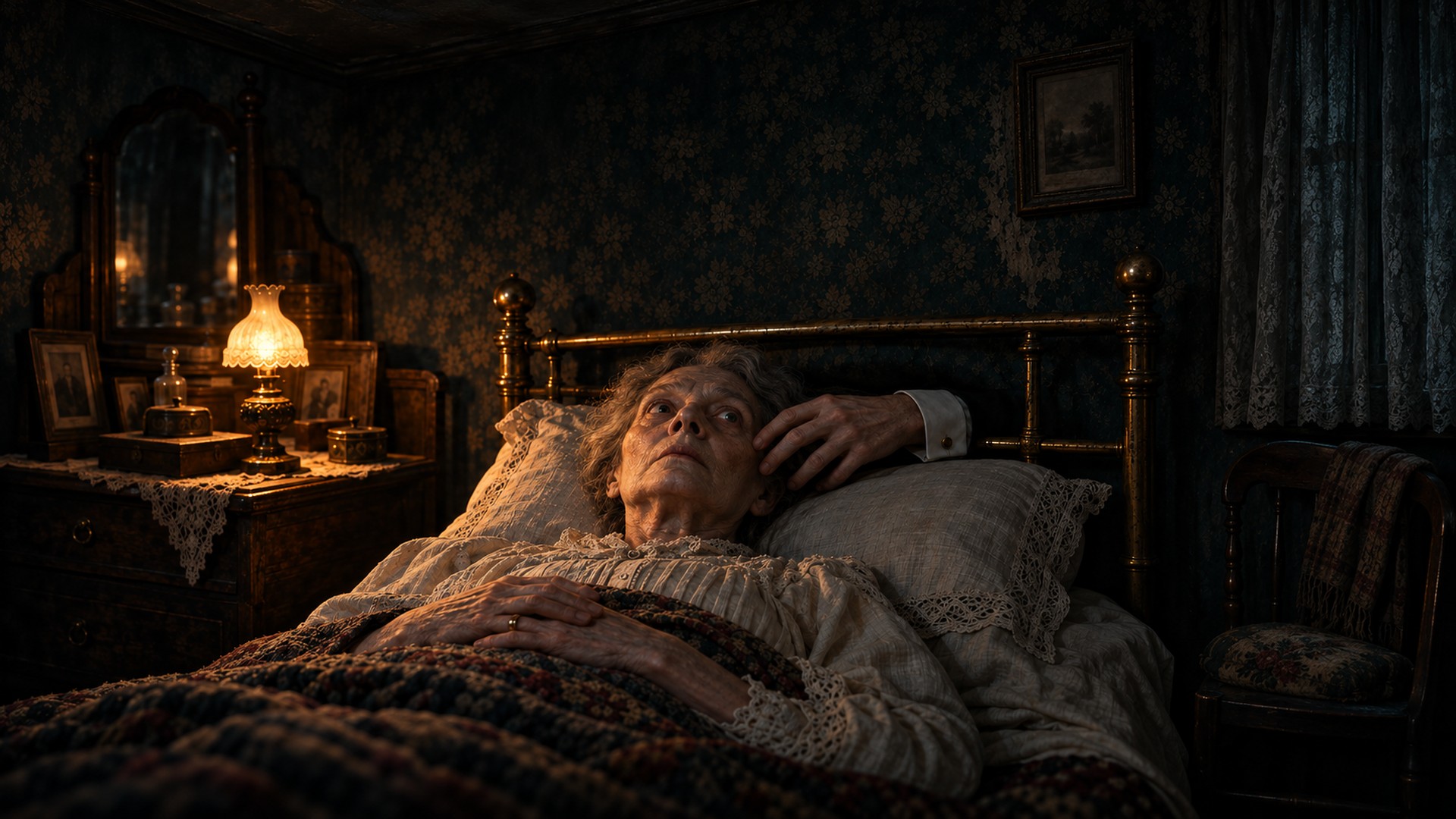
She was in the room she hadn't let. The door stood open, and for a second I thought she'd put her things away and lain down on the bed to rest.
Her shoes were together. Her hands rested on her stomach, with the fingers neatly interlaced. The hat had been placed on the washstand.
Ruth's eyes moved towards me.
A hand came round from behind the pillow and lowered her eyelids.
I went straight to the bed. There was a white cuff against her neck, with a man's forearm extending behind the pillow. The bed stood against the wall. I couldn't see where the rest of him could be.
“Get off her,” I said.
Her eyes opened again. She was making a sound through her nose, a small pleading noise which grew quicker when I reached for her.
The hand shifted beneath her chin and pushed her jaw shut.
I caught Ruth under the arms. Her body lifted, but her head stayed against the pillow, and she cried out through her closed mouth. I had to lower her again. Whoever had hold of her was hurting her worse when I pulled.
Arthur stood in the doorway. I shouted at him to help me.
He came as far as the foot of the bed and stopped.
Ruth got both hands around the wrist beneath her chin. She pulled at it until her mouth opened far enough to get the thumb between her teeth.
I heard the bite. The hand opened, and I dragged her off the bed so hard that we went down together.
For a moment I could see the space behind the pillow.
There was wallpaper there, worn by the brass rail. A cuff withdrew into the crease where the mattress met the wall.
Ruth was hauling herself towards the door on her elbows. I got her upright with my arm around her waist and guided her downstairs, taking her weight whenever her knees gave way.
The older lodger arrived while we were halfway down. He took her from me without asking permission and carried her into the kitchen. Arthur followed us, saying he'd go for the doctor.
“You fetch him here,” Ruth managed. “Tell him I'm awake.”
The lodger looked at me over her head. “I found her on that bed yesterday evening, laid out with her hands folded. I thought she'd died until she opened her eyes.”
Arthur was already in the passage.
“You knew about last night?” I asked.
He said his mother had been having turns.
“Did you see anybody go upstairs?”
“No.”
He answered before I'd finished. Then he went for the doctor.
The lodger wanted to search the house. I told him to get Ruth next door, where somebody could sit with her, and let the other lodger search when he came in. I couldn't have explained why the company mattered. I wanted people around her who would interfere.
Ruth caught my sleeve as we helped her across the passage.
“You said you'd cancelled it.”
“I crossed it out.”
I remembered the locked box. “The type's still there.”
I took her proof and went back to the works.
The street door was locked. Through the letterbox I could see the light we'd left above the counter. Everything appeared exactly as I'd expect after closing, except that I could hear the press.
Our main machine stood in the rear room. I'd worked beside it long enough to recognise the turn before it picked up speed, the uneven knock that meant the packing needed attention. Now it was making that preliminary turn over and over.
I unlocked the door and called the proprietor's name.
The knocking stopped.
I could have fetched someone from the pub opposite. I stood with the door open, hearing glasses on the counter over there, and considered it. Then I remembered Ruth on the bed. I went inside and left the door open behind me.
The main press was still. I could see the disconnected drive belt hanging where we'd left it.
In the composing room, a sheet lay on the little proof press. Ruth's notice was locked beneath it in an iron frame, the forme. Beside the press was a damp rag folded into a pad.
Somebody had already laid out the work for me.
I looked in the passage. The open street door made a yellow rectangle at the far end. Nobody stood between me and it.
The key to the forme wasn't on its hook. I searched the bench, then noticed that the proprietor's hold box had been left unlocked.
Inside were the completed jobs he never let us distribute back into the type cases. I'd complained about that often enough. Lead cost money, and we were forever short of useful letters.
There were packets of proofs underneath the trays. I pulled them out looking for the key, and the rubber band round one snapped.
They covered the floor at my feet.
These were from the last few years. I recognised nearly every name on the sheets nearest me. I could remember setting them, stopping for dinner halfway through some of them, leaving a space because I couldn't read a relative's Christian name.
Each proof had a second sheet attached.
The boot repairer's had a receipt for forty pounds. Beneath it was an instruction in the hand of a man whose circulars I also printed. He wanted the work completed before a partnership agreement came up for renewal.
I read the line about the wife twice. She was to be out when it happened.
Ruth's packet lay on top of the most recent tray.
Arthur had paid twenty pounds on account. The balance was due on publication. He'd supplied the hours when both lodgers were usually absent and asked that his mother should die in her sleep.
The proprietor had written underneath, “Proof to be delivered at the house before fulfilment.”
That requirement appeared on every account I turned over.
The obituary gave the instruction. The proof went ahead of it, with the victim's name plainly printed, and people brought it to relatives or put it aside to complain about later. Ruth had brought hers to me.
I had been paid five shillings to set each order.
Behind me, the proof press made a short scraping sound.
The sheet on its bed had moved. One corner was caught beneath the roller, and a wet line was spreading across the paper.
I found the key under Ruth's packet. Her death date was in the heavier face the proprietor used, and I could see where he'd fitted it after my work was done.
I shoved the accounts inside my coat and went to the press.
The roller was advancing so slowly that I watched it for several seconds before I believed what I was seeing. The handle on its axle was turning upwards. Nobody stood on that side of the machine.
A white cuff showed in the gap below the bed.
I fitted the key to the clamp holding the forme. My hand shook enough to make the iron chatter, and I had to use both hands before I could turn it.
The cuff moved.
I kept my eyes on the clamp. I had loosened thousands of them. There ought to have been no difficulty, yet I couldn't remember which way to turn, and the first attempt tightened it.
Under the press somebody drew a foot along the floor.
The roller caught my coat sleeve.
I tried to pull free, which fed another inch of cloth into the gap. My wrist struck the edge of the bed. The roller kept turning, drawing my elbow towards it while I tried to get my feet against something solid.
I could see where my arm would go. The machine would take it until my shoulder stopped it.
My mouth was open, but I was afraid a shout would bring whatever was under the press out towards me. That seems foolish now. There were people across the street who might have heard me.
The key was still in the clamp.
I turned it with my free hand and felt the pressure come off the type. The letters tipped against each other. All I needed was to break up the name.
I had to brace my free hand against the press to keep my balance. My trapped hand could reach the type if I let the roller take more sleeve.
I pushed my fingers into the loosened line.
The roller touched my wrist.
I got hold of the capital letter of her surname and pulled. It came with two smaller letters, scraping a cut across my palm. I dropped them, reached again, and felt my cuff button crush against the iron.
The roller stopped.
I stayed there with my fingers crooked above the broken line. A letter slipped from my hand and struck the floor.
Below the bed, something moved against my shin.
I screamed then. I pulled until the seam at my shoulder tore, and came away leaving most of the sleeve in the press.
There was room beneath that machine for a man to lie down, if he didn't mind the oil. I could see the floor through it now. The white cuff had gone.
I tipped Ruth's forme onto the boards and stamped through the scattered type. Then I stood in the doorway for a while, afraid to turn my back on the rear room long enough to reach the street.
Ruth lived. The marks beneath her jaw stayed for weeks, and for several days she could only manage food from a spoon. Her lodgers took turns sitting with her. Neither man ever asked me for an explanation.
Arthur came back with the doctor while I was at the works. Afterwards, in front of Ruth, I made him read the account I'd taken from the box.
“He said you wouldn't know,” Arthur told her.
Ruth asked the older lodger to see her son out. Arthur tried to speak again, and the lodger took him by the coat.
I told her I was taking the other accounts to the police in the morning. I meant it when I said it.
My hand needed dressing first. By the time that was done, the works were beginning to stir. I went back before the others arrived to collect the job books.
A new notice stood in the morning forme.
I recognised the spacing before I read the proof. I always allowed too much room after a full stop, and pinched the spaces beside the word “and” when I needed to save a line. There were other habits I couldn't have described until I saw them there.
The type was set exactly as I would have set it. I'd been elsewhere, having my palm bandaged.
The proof had been folded wet. My name appeared backwards on the facing half, faint enough that I had to bring it to the window.
It gave my trade and my sixth share in the newspaper. There was a space for the death date.
I put the accounts back in the proprietor's box, except Arthur's, and sat down to the next job. The man named in it had lent me his coat at my father's funeral. I knew where he lived. I didn't go.