
Read along
I paid the last six dollars on Mrs. Varga's freezer because I was tired of waiting for her to ask me.
In the second week of December, nineteen eighty-three, Garland's announced we were closing on Christmas Eve, and a boy whose mother I'd sold curtains to started teaching me how to write a stock label. Thirty years behind the basement layaway counter, and apparently I'd been doing it wrong. At fifty-two I was Dee to him because somebody upstairs called me Dee, although he'd have had the sense to call a man my age mister.
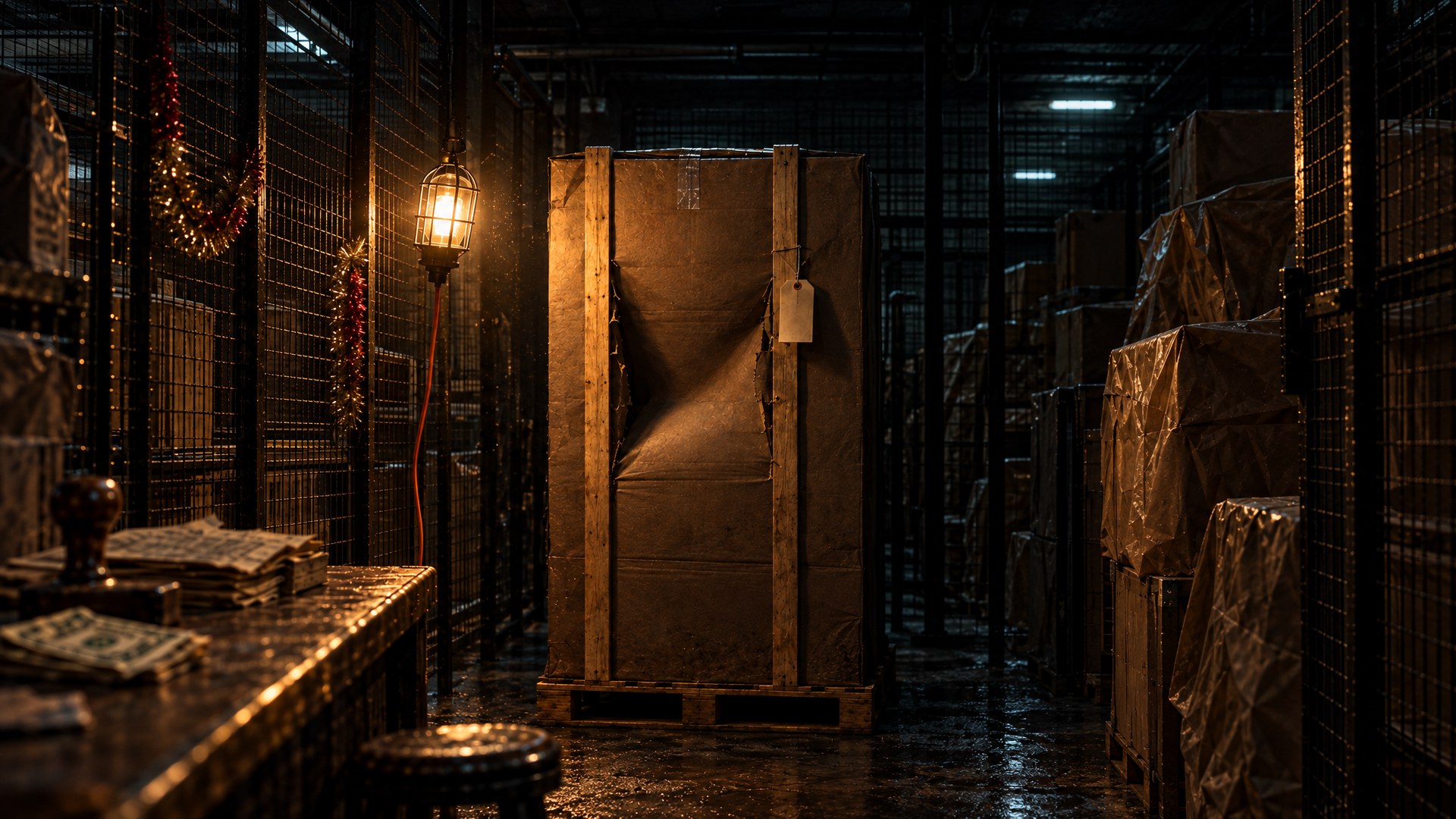
Mrs. Varga still called me Dolores. She'd been coming in on Fridays since nineteen sixty-one, usually with two dollars for account seventeen. The current purchase was an upright home freezer, according to the merchandise tag. We kept big appliances in reinforced cartons on wooden bases, beyond the wire gate behind my counter.
You could keep an account for years, exchanging curtains when you moved or changing your mind about a rug. I knew Mrs. Varga's payments better than I knew her purchases. Two dollars, counted out before she reached me. Some customers made you ask.
I'd held a Christmas coat till February for a woman whose furnace gave out, although I was supposed to send it back upstairs. When she finally collected it, we talked about the weather.
The Friday before our last week, Mrs. Varga waited while I explained to a man that Christmas didn't cancel the balance on a bedroom suite.
"How's my girl Dolores managing?" she asked when he'd gone.
"Ask me when I get my pension papers."
She gave me two dollars, and I entered the payment and told her she had six left.
"We've got a truck going out the last morning. Save you hiring somebody."
Mrs. Varga asked whether the men announced what they were bringing.
"They'll have your delivery slip."
"I mean at the house. Do they say it where people can hear?"
"They'll probably ask where you want the freezer."
"My husband has a temper about spending. I'd need to deal with it while he's out."
She'd mentioned him before, saying he wouldn't care for this, he'd have something to say about that. I'd never met the man, yet I disliked him with the confidence you acquire over a counter. I'd watched her turn down a marked-down scarf that would have suited her, and I blamed him for that too.
I also thought a woman her age ought to be past asking permission. Having never married, I had plenty of opinions about managing a marriage, and I'd been able to keep all of them.
She asked whether another store could carry the balance.
"You'll spend six dollars just getting to another store."
"When the men knock, will they wait? Will they let me see who's at the door before they bring anything inside?"
I said they'd knock first, of course, and she apologized for being a nuisance. That annoyed me more than the questions. At Garland's I could explain a delivery to anyone who asked.
Unpaid goods would be opened for Saturday's clearance sale. Paid appliances would leave on a hired truck. The regular drivers were already gone, so the new crew would collect their route sheets Friday evening.
"Could you leave mine till Friday, Dolores, while I speak to somebody?"
"If another store will take the balance, have them telephone us."
"I think I'd do better going there myself."
I checked her address, a row house in East Baltimore, and asked when her husband would be out.
"Saturday morning, if it comes to that. I'll come here Friday and let you know."
"You'll want to come early. We finish downstairs at four."
She asked me to write down the time. Her fingers were stiff, and I thought of her standing at bus stops in December to borrow six dollars while I sat right there with a drawer full of money. I wrote Saturday morning in the margin of her order.
On our last Friday a woman collected a bedspread she'd been paying for since July. Her mother was coming for Christmas, the first visit since she'd moved into her own place. She opened a corner of the wrapping to check the roses were blue.
"She's particular," the woman said.
"I gathered that in July."
She laughed, then reached across and squeezed my arm. She said she wouldn't have had anything decent for the room without me keeping it for her.
I didn't know who would tell me about their Christmas visitors after the store closed.
Mrs. Varga hadn't come by four. I called her house, but the telephone just kept ringing. The sales floor would stay open till nine. Late customers could leave payment envelopes through the slot beneath my counter, and she knew about the slot.
But her freezer would be opened in the morning. Somebody with cash could take it away, and I'd have to explain that to a woman who'd gone without a scarf.
I found her absence convenient. If she'd been there, she'd have argued, and we'd have spent twenty minutes discussing six dollars when I could settle it myself and have her order upstairs before the truck crew came for their papers. I could afford six dollars, having spent more than that on a retirement cake for a woman I couldn't stand.
I took the money from my purse.
The order specified delivery inside the front entrance, unpacking left to the customer. Plenty of people chose that when they had someone to install an appliance. I put seventeen on Saturday's morning run and brought the account to zero.
Paid in full. I pressed the stamp hard enough to get all the letters.
I'd tell her we could settle between ourselves after Christmas, although I had no intention of taking her money. She could buy me lunch, since we'd both have time with the store closed.
I took the sheet upstairs, then returned to the basement for my final freight check. The gate stood behind the counter, opposite the stairs. I borrowed the trouble light and carried my book through.
The men had gathered the remaining freight near the cage's closed end. Where we'd once had room to turn a sofa, there was a narrow aisle. I worked down it, reading numbers aloud because I'd always done that.
Seventeen stood near the end, and I went past it to reach the tag on the far brace.
"Seventeen. Paid in full."
A man inside the carton said, "Paid in full."
We had a stockman who could imitate the service announcements, and I waited for him to tell me the store would be closing in fifteen minutes. He'd done it before, getting me into my coat at half past three.
"You can come out," I said. "I want to go home."
A metal clink came from inside, followed by leather rubbing against cardboard. I pictured a man shifting his belt buckle.
"Come on, now. I've had enough today."
The lamp showed tape running across the top without a break. Between two wooden braces, the cardboard began drawing inward. It kept moving until the staples tore slots in it.
The base creaked under a change of weight.
There were people upstairs, shopping, walking directly over my head. I heard a woman's heels cross the ceiling and followed that sound with my eyes. When I brought the lamp back down, the cardboard was being pulled inward higher up, level with my face. I lowered the lamp to my waist, then raised it to check whether I was seeing a shadow. The cardboard stayed bowed inward at face height.
I tried to work out how the stockman had got inside, crouching beside the freezer or sitting on it, until the cardboard pulled farther in than a freezer would allow.
Getting out meant passing within reach of that panel. I turned sideways, caught my coat on the dining table behind me, and jerked against it. For several seconds I couldn't make myself turn far enough to see what had caught me. I pulled until the lining tore.
"Are we going now?"
I nearly said yes.
There was no room to hold the lamp between myself and the carton. I carried it above my head, watching the side all the way past. At the gate I lowered the lamp, still waiting for the panel to break open behind me.
From the back of the cage, the voice asked more quietly, "Are we going now?"
Upstairs I told the floor supervisor someone had spoken inside seventeen. He asked whether I'd actually seen a man.
"The box was sealed. The cardboard moved."
"A freezer fills that box," he said. "Where would a man get in?"
That was what I wanted him to explain. He asked whether I could have mistaken where the voice came from, with all that freight piled around me. I said I supposed I could, though I kept thinking about the staples tearing loose.
He thought a stockman had been hiding behind the freight. He sent the guard to find whoever was still working downstairs, but agreed the carton should stay put until the morning crew could examine it together.
I watched him write HOLD SEVENTEEN on the dispatch clipboard.
"That won't go anywhere, Dee."
At home I kept revising what I'd say to Mrs. Varga. Every version began with how little six dollars meant to me, which sounded worse each time I tried it. By morning I had a whole conversation prepared in which she forgave me before I got to the box.
When I called the store, the supervisor answered.
"Tell me it's still there," I said.
He put the receiver down, and I could hear him asking someone where the clipboard was, then asking the same person whether the truck had left.
"The hired crew took their papers last night," he told me. "They didn't come up here this morning."
"You put it on our clipboard."
"I know where I put it, Dee."
When I called Mrs. Varga, she interrupted my mention of Garland's to ask whether the account was paid.
"I paid it yesterday, but listen, there's something wrong with the delivery."
The receiver struck a hard surface. Her breathing moved away from it while I kept calling her name.
A man picked it up and said, "She can't come back to the telephone."
At the store I found Mrs. Varga's envelope in the payment slot. The flap said two dollars, and beneath that she'd written, Please wait for me. I'll be here at opening.
I took it and the receipt while the supervisor arranged for someone to relieve him so he could follow me. I gave him her address and went ahead in a taxi.
Her street was busy with people carrying groceries home for Christmas. Mrs. Varga opened her door before I knocked. She had her coat on and her shopping bag looped over her wrist, but when I stepped aside to let her out, she backed into the hall and sat down.
The carton stood beyond her with its wooden base still whole. Cardboard had split outward between the braces, leaving a dark gap at the height of my knee, and warehouse dust lay across the hall runner.
From the kitchen came the sound of dishes sliding off a shelf into something metal. A cup rolled around inside it before the next stack fell.
"He doesn't know where anything goes anymore," Mrs. Varga said.
"There's been a delivery error," I called toward the kitchen. "My supervisor is coming. We can arrange to collect everything."
Another cup struck the metal container while I waited for an answer, wishing I'd stayed at the store for the supervisor.
A framed photograph slid out of the kitchen and broke against the opposite wall. In the picture Mrs. Varga sat barefoot on a bench beside another woman, laughing.
"That's from upstairs in my sewing room," she said.
The stairs were behind a door beside her chair. It had been shut when I entered and hadn't opened since. She watched me look at the door, then turned her attention back toward the kitchen.
The photograph had landed face up. Mrs. Varga put her shoe over the broken glass nearest the picture, leaving the two women on the bench visible between us. I wanted to reach for it, give her something she could take with her, but another drawer opened in the kitchen and she pressed her shoe down harder.
"Leave that, Dolores. Please leave it where he put it."
Mrs. Varga looked toward the stairs. "He had that room before I used it for sewing."
"Get your bag," I said. "We'll wait outside."
She lifted her wrist to show me she already had it.
"Could you put the account back the way it was?"
"We can talk at the store."
"He hasn't had a room here since nineteen sixty-one."
I asked whether he had another place.
"He's been with you, Dolores. At the store. That's what I've been paying for."
I looked at the receipt I was holding. Upright freezer, written in my own hand.
"My husband went away," she said. "When he came back, the address was all he still remembered. Inside, he kept opening doors. He couldn't find where he belonged."
A drawer scraped open in the kitchen, and she waited through the clatter of its contents falling.
"Our old manager took him in?"
"He helped me get him there."
"But you must have paid enough years ago."
"When I got close, the manager would change it to something more expensive on the account. That bought us a few more years."
The manager had died that spring.
"Yesterday I tried three stores," she said. "One man laughed. At the others I didn't even get to finish. When I came back to the store, the girl upstairs said you'd gone home."
"Why didn't you tell me sooner?"
"You thought I couldn't manage six dollars. What would you have thought of this?"
"I'd have listened."
"And then fetched somebody with a crowbar to prove there was a freezer inside."
From the kitchen came the careful scrape of a cup being returned to a shelf. Mrs. Varga stopped speaking before it touched down.
I told her to come home with me. She put her palms on the chair and began to rise.
The toe of a man's shoe appeared at the kitchen doorway, shedding gray dust onto the linoleum.
"Sit down, please."
Mrs. Varga was seated before he'd finished saying please.
"She can stay with me until we find somewhere else," I said.
A second shoe edged into view. Only the toes extended past the doorframe; the man wearing them stayed out of sight in the kitchen.
"Where would you put me, Dolores?"
"We could speak to the store. There's all that space now."
"And after the store?"
"A warehouse. I'll find somebody."
"Have you room at your house?"
I had a spare bed, and I'd been picturing Mrs. Varga sitting on it while I found her a towel. Now I pictured the hall outside that bedroom, with mine at the other end, and having to walk along it in the dark.
He waited for my answer, and Mrs. Varga waited too.
"I can't," I said.
"My girl Dolores."
The words came from beside my knee.
Beside my knee, a loose flap of cardboard bent into the carton. It stopped, then bent farther, widening the dark gap while I watched.
His shoes were still at the kitchen door.
The carton creaked as I backed toward Mrs. Varga's chair. I turned to watch the gap, and leather scraped across the kitchen floor. When I looked back, both shoes had reached the edge of the runner.
"Let her go," Mrs. Varga said. "She's done what she came for."
"Of course she can go. You'll pay her back and thank her properly."
Mrs. Varga held out her hand for the receipt. I wrote my address beneath the total, resting the paper against the wall.
"You come at any hour," I told her.
She folded it into her purse while I edged past her chair. I reached behind me for the knob and kept looking down the hall until I was outside.
The supervisor arrived as I came down the steps. I made him stay with me while I called the police from a neighbor's house.
I waited on the sidewalk while an officer went in. He came back saying Mrs. Varga wanted to stay. When I asked whether he'd spoken to her alone, he said her husband had offered to leave the room, but Mrs. Varga had caught his sleeve and asked him to sit beside her.
When the officer offered to ask again, she shook her head at me from the front window.
I mailed back her unopened payment. The following Friday her husband drove her to my house to repay two dollars of my six. He said she'd be back twice more, then she wouldn't need to bother me again.
When I offered to forget the money, he told his wife to thank me for offering, then insisted she'd bring the remaining four dollars on the next two Fridays.
On the second visit, I stood with her at the curb and whispered an offer to meet somewhere. Through the open driver's window, he repeated it back to us aloud.
By the third Friday we were well into January. I had to bend to the passenger window. She had the last two dollars in an envelope, and the glass was lowered just enough to pass it through.
"Couldn't I owe you till next Friday?" Mrs. Varga asked me.
"Give it to Dolores," her husband said. "She's been good to us."
I took the edge of the envelope, but she held on from inside the car, and I stayed bent down to her. Neither of us pulled.
When she finally released it, she thanked me through the opening, then tried to say something else while he raised the glass.
The next Friday the car was at my curb again. Mrs. Varga said she'd borrowed two dollars from me on New Year's Eve, which she hadn't, and that she'd like to pay it back. I said thank you and took it.
She still comes by every Friday with two dollars for something I've forgotten lending her. I go down to the curb for it, because he won't let her out of the car.