Read along
Ricky said I could make money carrying papers if I could afford the customers.
By the Friday after Thanksgiving, I had forty-eight accounts in Steubenville, including men who watched television with their lights off rather than answer the door. You could hear them laughing from the sidewalk. Sometimes I waited for a commercial so they couldn't claim they hadn't heard.
I was collecting for November, and at the monthly settlement the manager took what I owed for the papers, whether my customers had paid or not. If everybody paid, I'd clear thirty-four dollars. Six accounts on Linden would cost me nineteen dollars and fifty cents, because according to Ricky I was supposed to cover those myself. I'd promised Mom twenty-eight toward the electricity bill.
I was sixteen that fall, old enough to do that subtraction without help, although I did it several times hoping I'd left something out.
Ricky had marked Linden on the header of my card ring. I was to leave their receipts with the afternoon papers, before four, and pay them up with my own collections. He'd underlined the part about keeping off the porches after four, which I took to mean somebody worked nights and had a temper. I'd met customers who could get that worked up about a wet paper.
When Ricky taught me the route in October, we spent half an afternoon arguing with a man who claimed he'd paid already.
“Show the boy your receipt,” Ricky said.
The man's wife had it, apparently, and she was out. Ricky waited while he explained where she'd gone and why she needed to go there, then asked again. Eventually the man paid us to leave, calling Ricky back twice to explain how he'd be speaking to the manager.
Each account had a card with a tear-off receipt. The customer got the receipt, and the dated stub stayed on my ring.
“Keep that stub,” Ricky said. “Next month he'll say he paid for both months, and you'll want the date where you can find it.”
Ricky was twenty-four, laid off from the mill, carrying relief routes until he could stay with an uncle in Akron. At a sandwich counter he ordered two, took a bite of one, then complained that the woman had given him an extra.
“She charged you for it.”
“Well, I can't eat it now.”
I wrapped it up to take along before he could find another reason to complain.
“You buying lunch at school?” he asked.
“I've got parents.”
“Fine. You buying lunch?”
Ricky could spend a whole lunch hour at it, waiting until you ran out of answers. He'd shown me which customers gave Christmas tips, too, putting a pencil mark beside their addresses while I pretended I wasn't interested. I wanted him gone to Akron so I could have the route to myself. Then he'd asked what I was doing Saturday, and I'd said nothing, in case he needed help.
When we reached Linden, he copied the instructions from a header worn through at the ring. The previous carrier had insisted on them.
“Tell the manager to give you credit,” I said.
“That's what I'm going down there for, but he says they're active accounts.”
“Because you keep paying.”
“Eat your sandwich.”
I last saw Ricky several days later, going toward the shack with his collection book. When I went in to settle my bill later that week, the manager said he'd left for Akron, and when I asked about Linden he tapped the total on my bill. I asked him to check for a credit, so he looked at the same figure again and said I was holding up the line. You could lose an afternoon that way. He'd send you home to get a slip he'd never given you, and when you came back he'd be gone. I figured Ricky had got tired of it and left me to finish the argument.
Before I reached Linden that Friday, a customer came out with leftover pie. She stood holding the foil while I ate, although her television was on and I knew she wanted to get back inside.
“Take another piece for your dad.”
“He's all right.”
“Well, does he eat pie when he's all right?”
I took the extra piece, although I knew Dad would tell me to keep it, the same way he'd told me to keep my lunch money. I'd explained our electric bill to him, standing there in my school coat while he sat with another job application in front of him. You'd have thought he needed it explained.
Mom had asked for ten dollars when I could spare it. I'd said twenty-eight, loud enough for Dad to hear, and he'd drawn a line through something on his application.
Linden bent uphill above apartments and stores, with a laundromat directly across from the first house, its red sign lighting the bottom step. Two buildings hid it farther up the bend. From the last pair of porches you couldn't see the stores at all.
I hadn't seen anyone take a paper inside on Linden. I'd reported the wet bundles under the mailboxes, and the manager said people went away, people worked doubles, people wanted their papers saved. He could name plenty of reasons without getting out of his chair.
So I left new papers on top of old ones, and that night, shortly before six, I went up the first porch.
From inside the hall, a man asked how much he owed.
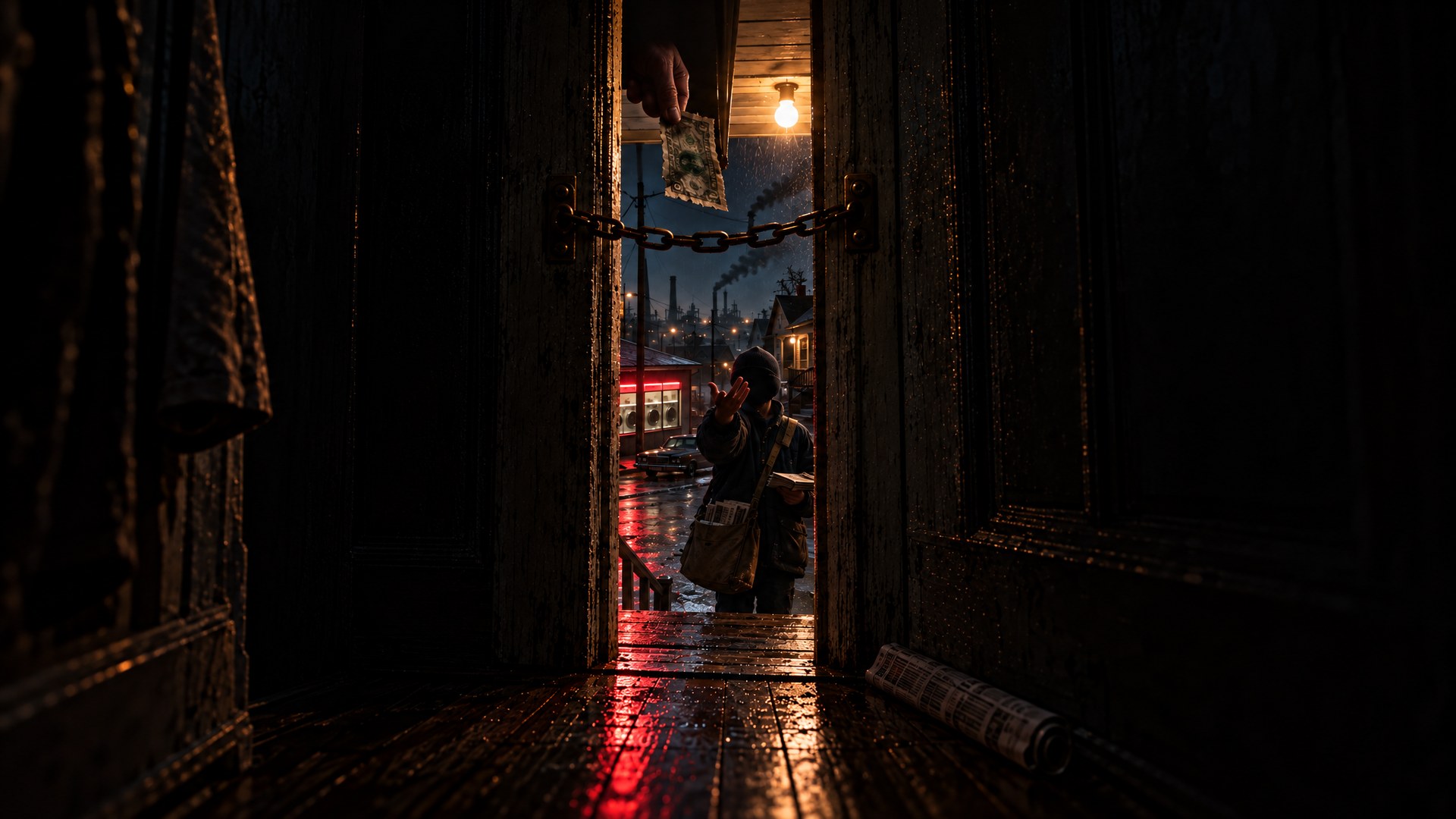
His voice sounded high up, where stairs might have been. The chain was a length of hardware-store chain fastened between two screw eyes, long enough to let the door open the width of my spread hand. Someone had tacked folded newspaper along the door's bottom edge to stop a draft. Across the street a woman was lifting clothes out of a dryer, shaking each piece before she folded it. I watched her while I waited for my money. I was trying to think how I'd tell Ricky that six people had paid me just because I'd asked.
When I gave the amount, a sleeve reached into the gap holding money, and I tore off the receipt. The red laundromat light crossed the bare floor behind the door.
One dollar had a corner missing, and two quarters stuck together with brown rubber-band residue that came off on my thumb. I put the payment in the front pocket of my pouch, away from the money collected downhill.
At the second house I knocked twice before anybody answered. While I waited, a dryer at the laundromat started rattling, loud enough to hear around the bend.
“How much do I owe?”
The man held out his payment while I was still giving the price. I separated sticky quarters and handed him the receipt, which he took between two fingers. The dollar had a corner torn away, too, and I wondered whether the first man had broken a larger bill for his neighbor, giving him the rest of some old money he'd kept bundled up.
At the third house I stood where the porch light would reach the payment. Again the dollar was damaged, and I rubbed my thumb over the tear.
“Do you all get your change from the same place?”
The receipt slid out of my fingers, and the door shut before I could look up. I stood there wondering whether I'd sounded rude, then put the money away. I remember that clearly because at the fourth porch there was only three dollars and twenty-five cents in the pocket.
I counted twice under the bulb before checking the other pocket and the ground behind me.
My delivery bag had room to spread the money, so I crouched and emptied the front pocket into it. I could hardly make my fingers leave the seams alone. Dad had said to use the pouch with the zipper.
“Six fifty gone, Jesus, I promised my mother twenty-eight dollars and I've got...”
I started again, counting the same coins aloud.
The door opened above me, and a man asked how much he owed.
A torn dollar waited in the gap while I looked down at the torn dollar in my bag.
The one in the doorway slipped back out of sight. In the bag, the bill jerked beneath the coins, scraping them across the canvas. The torn edge of the bill pointed toward the threshold, and when I caught the bag against my chest the quarters pulled the fabric tight. I could feel their hard rims through the canvas.
When I tried to stand, I hauled up on the strap, but the bag kept pulling toward the door. My weight pitched forward toward the opening before I understood and let go.
“Leave it, Toby.”
The bag fell with its mouth toward the door, and everything inside stopped moving.
That was how Ricky spoke when I tried carrying too many bundles. I backed into the porch rail, then went down the steps with my hands held out because I couldn't seem to lower them.
From the sidewalk I could see my bag where it had fallen. I rubbed my palms on my jeans and waited for Ricky to come out laughing. He could tell everybody at the shack what my face had looked like, and I'd stand there while he did it.
“Ricky?”
When the fourth door closed, I started downhill, calling once more over my shoulder.
A car went past the bottom of Linden. I waved, too late for the driver to see, and was about to run after it when somebody coughed uphill.
Ricky's cough at the shack had the same whistle at the end.
“How much do I owe?”
I went toward the last house, staying on the sidewalk. I couldn't leave without seeing whether it was Ricky.
Four hundred and twenty-two was painted on the porch post. From there I could still see my bag at the fourth door.
“Toby. You ought to go and get your...”
Ricky strained at the next word, and while he was still making that sound, his voice started the sentence again, clearly enough for me to hear every word over the effort underneath.
“Toby. You ought to go and get your...”
Both voices stopped at the same place, then the door opened and I heard Ricky trying to swallow. I waited with my hands in my pockets, gripping the lining. I tried clearing my throat to make some noise between us, and stopped because I couldn't bear to hear that come back too. Behind the door Ricky took several little breaths. I heard each one stop before he'd had enough air.
“Have you been buying lunch?” he asked.
I wanted to tell him about the pie, and to offer him the piece I'd wrapped up for Dad.
“Come outside, Ricky.”
“Three dollars and twenty-five cents.”
“Come down here with me.”
“Stay there.”
Something scraped above the doorway, dragging against plaster. I saw a shirt button in the gap, higher than my head, then it disappeared upward. The chain rattled against its screw eye, though the door hadn't moved at all.
“I'll get Dad,” I said. “He's home, I can have him here in ten minutes.”
Ricky made a sound through his teeth that brought me onto the porch, trying to hear.
“Read me that score.”
The words came quickly, in the easy voice. A sports page hung from the chain, and Ricky's fingers appeared beside it, reaching down. I waited for him to point, but he curled his fingers into his palm.
“Under the picture,” the easy voice said.
I had my bicycle flashlight in my coat. I crouched to read the page hanging below the chain, moving the beam past its curling edge.
A foot above the floorboards, Ricky's bare feet hung in the light.
One heel had a gray patch of dirt, and he kept rubbing the other foot against it. I wanted to put a hand underneath and hold his foot steady. Instead I found myself looking for his shoes, which was stupid, but I couldn't picture taking him home barefoot in November.
I aimed lower, searching for a stair beneath him. The beam reached the baseboard across the room. There were clean floorboards under both soles.
“What are you on?”
His knees drew up, and the scraping overhead went on until I stopped asking.
Beyond his feet, a red stripe crossed the floor. When I turned off the flashlight, I saw another door standing open on a chain, a few feet behind him, and through that opening I could read the laundromat sign.
I checked the number on the porch post again.
Through another gap inside, farther to my right, I saw my delivery bag with its strap hanging over the fourth porch.
As I moved my head along the opening, six chains caught the light around the room.
“Ricky!”
My call came out of the fourth house, downhill behind me.
“Went back for mine,” he said.
His voice was above the door now.
“Don't come through.”
An interior door opened behind his feet, letting yellow light reach the floor, and I heard coins being set down in the room beyond.
“There's twenty-eight dollars here for your mother,” a man said.
I stood and caught Ricky's sleeve, his arm dragging heavily inside the cloth. I pulled down, trying to bring his hand within reach of the chain.
“Undo the chain,” I said. “Ricky, I can't get to it from out here.”
His chin appeared at the top of the gap. His mouth opened, working at a word, while I kept hauling on the sleeve.
Then his chin began to rise again.
As I pulled harder, his lower lip flattened against the wood at the top of the opening. I loosened my grip, begging him to stop talking, and his mouth disappeared above the frame while the cloth slid through my fingers.
With my free hand I pushed the door against its long chain. I turned my head sideways to judge whether I could get through far enough to reach the screw eye.
“Toby.”
His voice had come from directly over my head. I stopped with my cheek against the edge of the door, waiting for him to say what to do.
“How much do I owe?”
I let go of his sleeve.
Backing downhill, I watched the last opening until the bend hid it.
“You can take it home,” the man said from the fifth door.
I hurried past the fourth porch, leaving the bag.
“Your mother's waiting.”
The voice came from the third door now. At the bottom I had to wait for a truck to turn while coins clicked together behind the first opening. I ran across before the driver had straightened his wheels. Under the streetlight I checked the three torn stubs on my ring.
At home, Dad got up when he saw me. I started with the money, and he said never mind that, where had I been?
Mom tried taking my coat off, and I held it shut until she left me alone.
When Dad asked whether Ricky had been drinking, I said I didn't know. When I got to the feet, he looked at Mom, then asked me to say that part again. I thought he was going to make me stay home, and I caught his arm before he'd even reached for his jacket.
We went back together.
“It's Toby's father,” Dad called through the gap at four hundred and twenty-two. “Remember helping me load the scrap?”
“Watch the tailgate.”
Dad looked down at the threshold.
“That's right. Damn thing nearly came off. Come on down here, Ricky.”
The scraping started above us. Dad pushed me behind him and put his shoulder into the door until a screw eye tore out.
Inside was an empty front room.
Dad went upstairs calling Ricky's name. I stayed beside the wall where the other doors had been. Wallpaper peeled from a crack near the ceiling. I pressed my ear to the wall below it while Dad searched the cellar. Dad came back up and stood in the kitchen on the other side.
“Knock where the opening was,” he said.
I knocked. He came around again and laid his palm over the spot. He kept it there, feeling for movement in the plaster, until I said I wanted to go outside.
The door swung shut behind us.
“How much do I owe?”
Dad grabbed the knob, then stopped. His hand stayed there while he looked at me.
“You heard him?” I asked.
“I heard.”
After Dad reported Ricky missing, the police searched all six houses, and Ricky's uncle told them he hadn't arrived. Dad stood with the officers and called through the doors. Ricky wouldn't answer. An officer came to our kitchen afterward and asked Dad again about drinking. Dad made him write down what we'd heard about the tailgate.
He also went with me to cancel the six subscriptions. I still owed November's nineteen dollars and fifty cents, leaving fourteen dollars and fifty cents for Mom.
“I asked you for ten,” she said, counting it.
An assistance payment kept the electricity on while Dad kept filling out applications.
We returned to Linden to try getting Ricky to answer questions through the closed door. Dad wanted a policeman there when he answered. Sometimes Ricky coughed, but he never spoke while an officer was on the porch.
By March, Dad was bringing a sports page on Fridays and waiting at the curb while I read through the chained opening. The last time, I'd chosen an article calling for a coach to be fired. Ricky used to argue about that coach until his sandwich went cold.
There was no answer from above me.
From the lighted room farther back, the other man said, “Twenty-eight every Friday. You could have these houses again.”
I kept reading.
“Would your father prefer to collect?”
Dad pointed to his ear from the curb. He came toward the steps, asking whether Ricky had said something.
I said Ricky hadn't spoken, which was true, and Dad stayed at the bottom step.
I never told Dad about the offer. The next Friday he wanted me to wait at the curb, and I did.