Read along
The scales on this fish don't match anything in our oceans. They belong to a creature that died out three hundred million years before the first human walked the earth. And yet, the locals are frying it up for dinner.
I want to be precise about that, because precision is the only thing I have left. My name is Thomas Thorne. I was, for nineteen years, a marine biologist with a university appointment and a lab with my name on the door. Then I published a paper on a deepwater species out of the Bering Sea that turned out to be built on contaminated samples, and the retraction ran in the same journal, two columns wide, under a headline my mother would have clipped out and kept if she had still been alive to read it. The university let me resign. The state of Maine, which does not read journals, hired me at eleven dollars an hour to count fish.
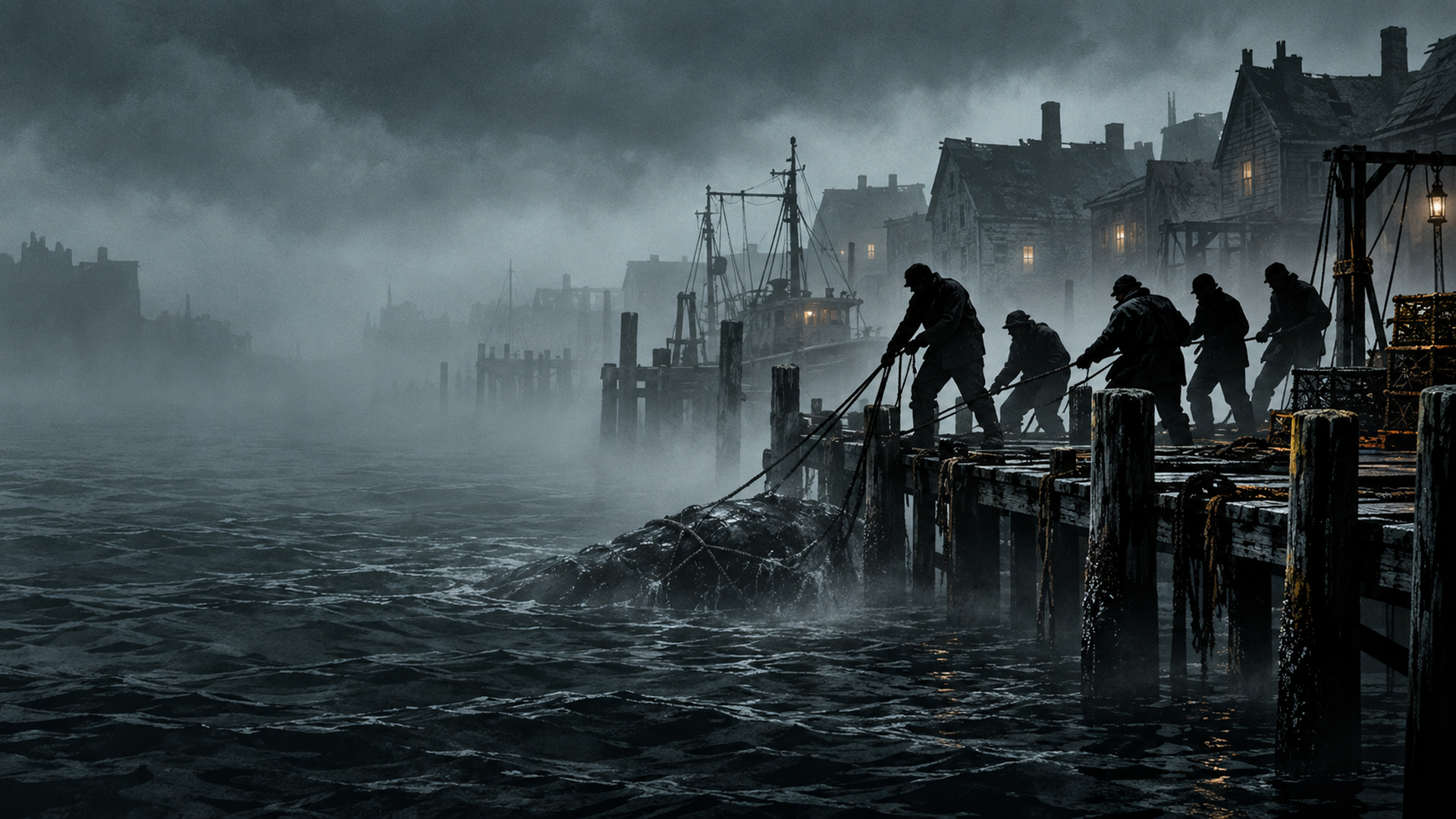
So in the last week of October I drove north to Blackwood Harbor, the town I was born in and left at eighteen, to audit the daily catch for the fisheries office. The fog met me at the county line and never left. It sat on the road and on the water and in the throats of the few people I passed, and under it the whole town smelled of kelp rotting on the rocks, a smell I had not thought about in twenty-nine years and recognized before I had my window all the way down.
The harbor master's office is a shingled box at the end of the town wharf, and the harbor master is a man named Aldous Pettigrew, who was old when I was a boy and is older now, with hands that look boiled. He did not shake mine. He handed me a clipboard and walked me out to the boats.
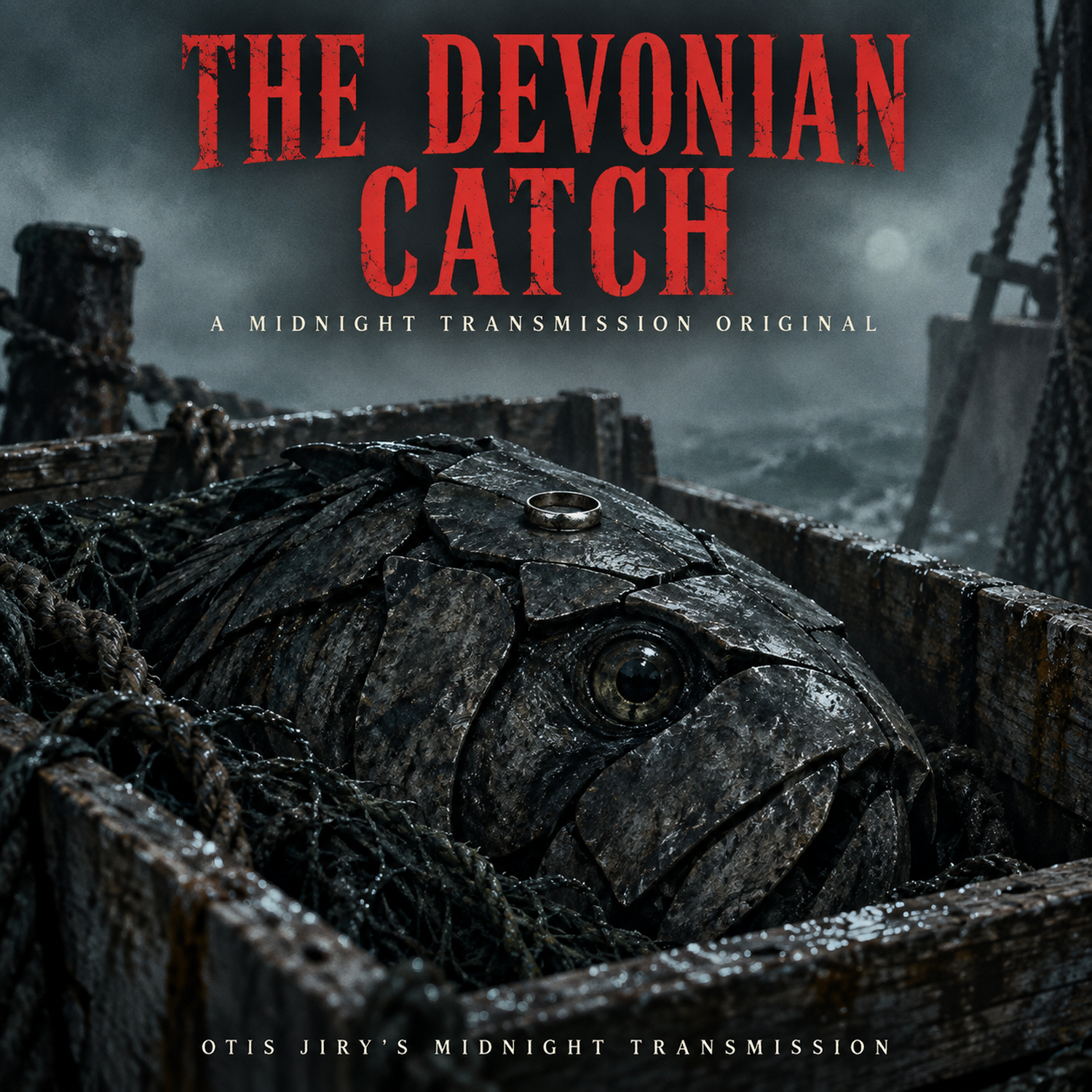
The first crate came up off the Marguerite at a quarter to seven. I had my pencil ready to write haddock, or pollock, or cod if the season had been kind. What lay in the crate had no scales at all on its head. It had plates. Bone armor, interlocked, dull grey going to black along the seams, and a jaw with no teeth in it, only two shearing edges of bone, one upper and one lower, the way a paper cutter has a blade and a bed. The whole animal was longer than the crate and had been folded to fit. Its eye was open, and wet, and looked at the fog.
I know what a Dunkleosteus looks like. Every child who has ever loved a museum knows. There is a cast of a skull in Cleveland the size of a car door. That animal has been dead since the Devonian.
"Log it as armored," Pettigrew said. "That's what we call it."
"You can't call it anything. It doesn't exist."
He looked at me the way you look at weather. "Trench has been generous this fall," he said, and moved on to the next boat.
The next boat had coelacanths. Four of them, blue as slate, the lobed fins still moving a little on the deck. Then more of the armored ones. Then a thing with a spine like a saw blade down its back that I knew only from a textbook plate, and could not have sworn to, and did not try to. By nine o'clock I had logged two hundred and eleven animals that should not have been in any net on earth, and eleven haddock. The crews worked around me. Nobody stopped to stare at what they were hauling. A woman in oilskins gaffed a coelacanth by the gill and swung it onto the scale with the same wrist she would have used on a cod, and read the weight off to Pettigrew, and he wrote it down. A boy of maybe fourteen hosed the deck of the Marguerite and whistled while he did it. When the hose caught the open eye of the big one in the crate, the eye rolled to follow the water, and the boy did not look down.
I ate lunch at the diner on Front Street because it is the only place to eat in Blackwood Harbor and because I needed to sit down. The waitress was a woman my age named Della who remembered me and did not say so. The special was on the board in chalk. Mother's Broth, four dollars, with bread.
"What's in it?"
"Fish," she said. "What else."
I ordered it, because I am a scientist and I wanted to see the meat. What came was a bowl of pale stew with pieces of firm white flesh in it, and it was sweet. Not sugar sweet. Sweet the way a stock gets when somebody has been patient with it, bay leaf and onion and a long low heat, and something under that I did not know and then did. My mother made stew that tasted like this. She made it on Sundays with whatever my father brought in, and she hummed while she stirred, and I had not tasted it since the winter I was eighteen, because that was the winter she rowed out past the point in the fog and did not row back.
I put the spoon down. Then I picked it up again and finished the bowl, and I want to be honest about that too.
I spent the afternoon at the cemetery, which I said was to see my father's stone. The stone is there, where I left it. What is not there is anybody else from his generation. I walked every row. The stones stop around the year I was born and start again with the young: a drowning, a car on the causeway, a girl of nineteen. Nobody old. No Pettigrews, no Coombs, no Marguerites. A town of fishermen with no old dead.
The town office keeps a ledger, and the clerk let me read it because I had a state badge on a lanyard. Sea burial, the entries said, one after another, going back decades. Committed to the water off Blackwood Point. Each one certified by the harbor master, and each signature the same slanting hand. My mother's name was in the book. Presumed lost, it said, and then under it, in the same hand, Committed, and a date three days after she went out.
Nobody had told me there was a service.
There were posters on the office corkboard. A couple from Ohio who had come up in September to see the leaves and had not gone home. A man with a red kayak. A hiker. Their faces were already curling at the edges in the damp, the way everything in that town curls.
I took a coelacanth back to the room I had rented above the hardware store, laid a plastic sheet on the table, and opened it.
It was warm.
I had been carrying it for twenty minutes in a cooler, out of the fog, and the body cavity was warm when I put my hand in. I checked with the probe thermometer I keep in my kit. Thirty-six point four degrees. Fish do not do that. Tuna manage a few degrees over the water they swim in and it makes them famous. This was the temperature of a person.
I had a blood typing card in the kit, the kind a field medic carries, because a long time ago I did field work where that mattered. I do not know why I used it. I think I wanted a number that would make the warmth an instrument error. I pricked the heart, which was still soft, and dropped the blood on the card and waited.
O negative.
Fish blood does not type. It has no business on that card. I ran it twice more, from the liver and from the gill arch, and got the same answer three times, and then I sat on the edge of the bed with my hands in my lap until it got dark.
In the morning I asked Pettigrew for one of the armored ones. He gave me the biggest on the wharf without a word, and two of the crew carried it up the stairs for me, and I cut it open on the floor because the table would not hold it.
There is a certain order you learn to open a fish in, and I kept to it, because the order was the only thing between me and the door. Gut cavity. Liver. Stomach. The stomach was full, and what was in it was not other fish.
The first thing I lifted out was a gold crown. A molar, capped, the sort of work a dentist in Bangor does for a man who has waited too long. Then a length of white cord that was not cord, that was a tendon with a stitched repair in it, the black nylon still knotted. Then a hip. A hip joint, the ball of it, and seated in it a pin of titanium with a serial number etched along the shaft, seven digits and two letters, a number that sits in a file at a manufacturer in Indiana next to a name.
I wrote the number on my hand.
Behind the stomach, in the gullet where the bone blades meet, there was a mass of softer material that the animal had not finished with, and I did not go through it. I scraped it into a steel tray and covered the tray with a towel and set it on the windowsill in the cold, and I said I would come back to it when I had slept, which was a lie. I did not sleep. I sat at the window and watched the boats go out at four with their lights on, into fog you could not see ten feet into, and I listened to the town wake up under me and put its coffee on.
That evening I walked to the end of the wharf and found Pettigrew in his office with a kerosene lamp going, doing his books.
I put the crown on his desk. I put the pin next to it and read him the number off my hand.
He looked at them for a long time. He did not seem surprised, and he did not seem caught. He looked tired, the way a man looks who has been waiting for a particular knock on a particular door for most of his life and is a little relieved, now, to hear it.
"Sit down, Thomas."
I sat.
"You know the trench," he said. "Out past the point. Your father fished the edge of it. Everybody did, and nobody went over the middle, and nobody could have told you why. Then the cod went. You remember. Sixty families to twenty in ten years. I buried a lot of people in those years, and there was no money to bury them with. So we put them in the water, over the trench. That was the only thing we did differently, Thomas."
The lamp hissed. Out on the water something big turned over and went under.
"And the trench gave back," he said. "About a month after the first one. The Coombs boy pulled up something with plates on it that his grandfather wouldn't have known the name of and you would. It was fresh. It was good eating. And it came up over the very place we'd put Alma Coombs in the water."
"That's not possible."
"No. It isn't. And there it was in the net." He turned his boiled hands over. "We're a fishing town. We fished it. Every one we put down, we got back, and more besides. Ten times the weight. Enough to feed everybody and sell the rest down the coast as something exotic, at a price. Nobody asked. The kind of people who buy that kind of fish don't ask. The town came back, Thomas. You've seen it. The school's open."
"The people on the posters."
He was quiet for a moment.
"It wants feeding," he said. "It doesn't care what. But the more it gets, the more it gives, and we found that out, and I won't pretend to you that we didn't."
"They were alive."
"Some of them." He said it without any weight, the way he had said the trench had been generous. "Not from here. Nobody from here has ever gone in who didn't ask to."
I stood up. I had come with a speech about the police and the state and the university and I found I did not have any of it left. What I had was one question, and I had known since the diner that I would ask it, and I had known since the ledger what the answer would be.
"My mother."
"She asked," Pettigrew said. "She was the first. She was sick, Thomas, in a way you were too young to be told about, and she didn't want your father to have to pay to put her in the ground when the ground was all he owned. She rowed out herself. I signed the paper three days after, because that's when the water let me. She was a good woman and she made a better stew than any of them, and I'll say that to anybody."
I walked back through the fog along Front Street. The diner had its board out and its windows steamed, and through the steam I could see the counter full, the whole row of them bent over their bowls, and Della moving behind them with the pot. Past the hardware store, up the stairs, and I took the towel off the tray.
I went through the mass in the gullet with my bare hands, because the gloves were across the room and I could not make myself cross it. Most of it I did not know and did not need to. Near the bottom, held in a fold of grey tissue like something the animal had been keeping, there was a ring. Silver, worn thin on the underside from forty years of dishwater, with a scratch across the top I remembered from watching her hands. On the inside, where my father had paid a man in Rockland to cut it, two sets of initials and a year.
I have it on now, on my smallest finger, which is the only one it fits.
Here is what I understood, standing in that room. The fish I opened on the first night, the warm one, the one that typed O negative, was cooked and served at the diner on Front Street. I know that because I logged it and then I carried it there myself for Della's cook, because they were short and I was being neighborly. And the special on the board has been the same special for three days, and I have eaten it for three days, and it tasted the way it tasted because there is only one person who ever made it taste like that.
O negative. My mother's type. Mine.
I sat on the bed until the boats went out. I did not throw up. I want to say I tried and could not, but I did not try. Somewhere around four in the morning, in the quiet after the engines faded, I heard her. Not in the room. Lower than that. Under my ribs, where the broth was, a low tuneless humming, patient, on a long low heat, the sound she made on Sundays at the stove.
The humming is still there. It comes when I am hungry.
I did not drive south. I am a marine biologist, and there is a trench a mile off this town that returns what is given to it, and no one in the world knows about it but the people who live here, and I have the state's clipboard and a badge on a lanyard. The audit is due Friday. I will write haddock.
And in the morning I will go down to Front Street, where the board will say what it always says, and I will sit at the counter and let Della pour the coffee, and I will order what my mother made, because it is warm, and it is sweet, and it is the only way I have ever been able to get her to come back.