Read along
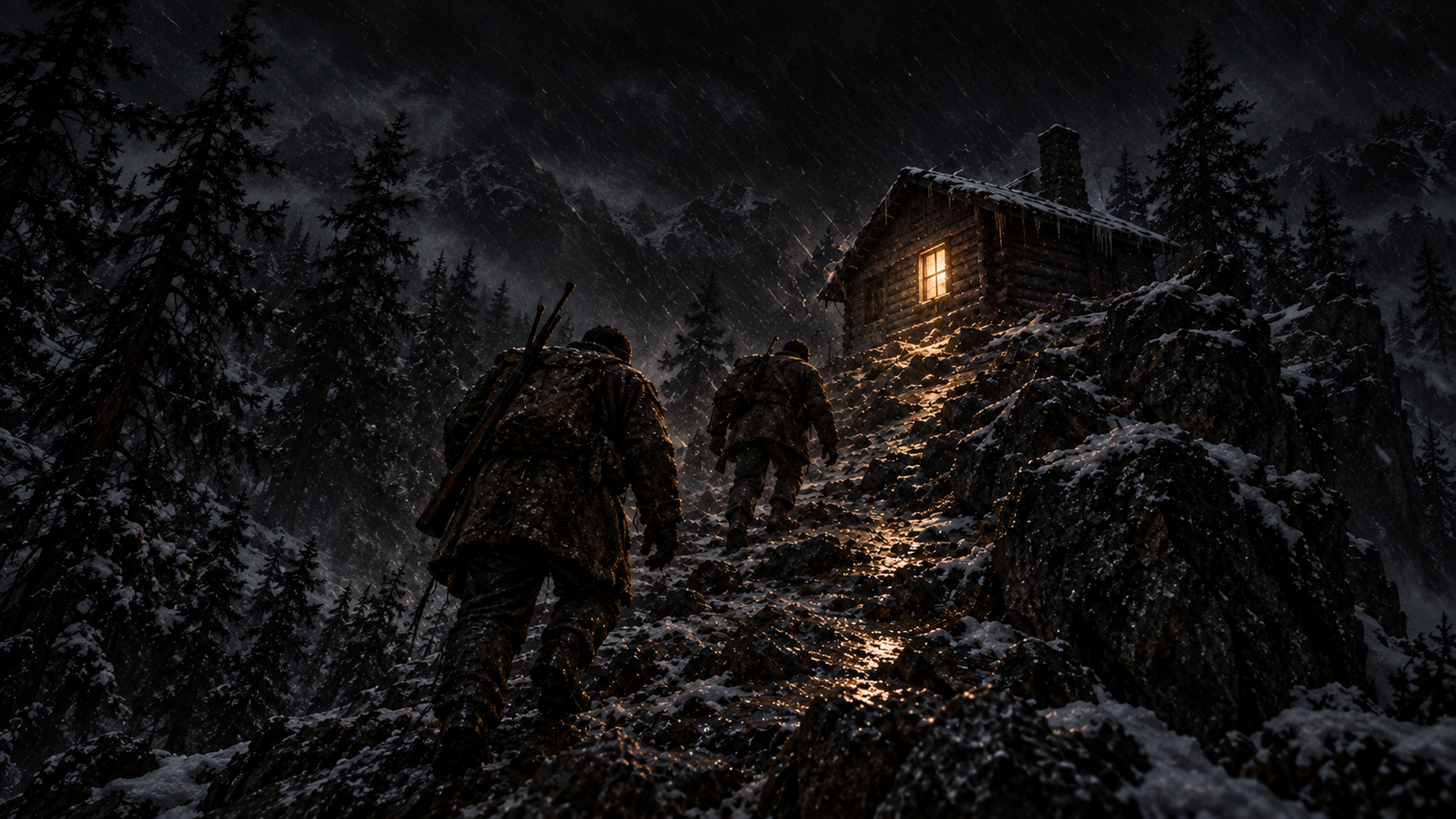
The storm found Algernon and Roderick two hours into their climb, and it did not politely announce itself. One moment the ridge trail sat under a bruised grey sky; the next, sleet needled sideways into their faces, and thunder cracked close enough to rattle the fillings in their teeth. They gave up on the day's hunt and started looking for any shelter that was not a tree. They found it first beneath the split roots of a dead oak, hunched together while hail rattled the leaf litter around them, and it was there that Roderick spotted the light: a single window, glowing gold, somewhere above them on the ridge. "Cabin," he said, and they did not discuss it further. Ten minutes of scrambling over wet stone brought them to a door. Roderick knocked. No one answered. He tried the latch, and it gave. Inside: one room, a woodstove, two cots, a lit oil lamp nobody claimed. No owner in sight, and no sign that one had left in any hurry. Their boots left the only tracks in the mud outside the door. They called into the dark corners twice and got back nothing but their own voices, flattened and small in the enclosed air. "Somebody's coming back for that lamp," Algernon said. "Then they can share the fire when they do," Roderick said, already feeding kindling into the stove. A coffee pot sat on the shelf, still faintly warm, though the fire beneath it had long since turned to ash. Beside it stood two tin cups, set out and empty, though the cabin held only the one lamp, the one stove, the two cots meant for exactly two men. Neither of them thought to question any of it until much later, when questioning it no longer helped either of them. They hung their soaked coats on a line strung across the room, drank the coffee without asking whose it was, and by the time the storm had settled into a steady drum on the roof, they were both half asleep in their cots, backs to the dying fire. Algernon woke to a voice at the edge of hearing, not loud, only close, the way a man talks in his sleep beside someone else in the dark. He did not open his eyes at once. He heard the door. When he did look, a woman knelt beside the stove, unbothered by the storm still hammering the window behind her, her clothes dry despite the weather that had soaked both men to the bone hours before. Her hair hung long, dark, and unbound. Her skin held the color of river stone at dusk. Her eyes caught the firelight without blinking, the way an animal's do, and gave nothing back. Algernon watched for the small rise and fall of her breath and could not find it. No fog left her lips in the cold room. No pulse moved visibly at her throat. She was looking at Roderick. Algernon lay still and watched his friend sit up to meet her, the two of them close, her hand flat against his chest as though she meant to feel something moving beneath his ribs. Roderick's mouth worked, forming words Algernon could not hear, and whatever she asked of him, he shook his head. Once. Then again, harder, his whole body drawing back from her the way a man draws back from a flame. She tilted her head at him the way a woman might study a child mid-tantrum, patient and entirely unsurprised, and then she looked past Roderick, across the room, and found Algernon watching. She crossed the floor without seeming to walk it. She knelt beside his cot the way she had knelt beside Roderick's, and up close he caught the smell: rain on stone, and beneath that something colder still, something that had never once in its existence been warm. Her hand covered his mouth before he could make a sound, and he did not fight her. Some old, animal part of him understood, immediately and completely, that fighting her would carry far-reaching repercussions he was not equipped to survive. "Tell no one of tonight," she said, low and even, each word landing with a weight that did not belong to its size. "Not this cabin. Not me. Not what you have seen your friend refuse to give me. Keep that silence, and I will let you keep your life. Say it." He said it. His voice came out smaller than he had meant it to. "Promise," she said. "I promise." She held his eyes a moment longer, as if weighing the word on some private scale, and then she was gone. No door. No footsteps. Only an empty patch of floor where she had knelt, and firelight pouring silently into the space she left behind. Algernon did not remember falling back asleep. He remembered nothing else until birdsong and grey morning light through the one window, and a room that held only himself. Roderick's cot was empty too. He found his friend outside, face down in the wet leaves twenty feet from the door, one hand still curled into the dirt as though he had tried, at the last, to drag himself somewhere. When Algernon turned him over, Roderick's eyes were open, fixed on a point in the sky that held nothing, and his face had twisted into an expression Algernon would spend the rest of his life trying not to remember. Not pain, exactly. More the look of a man who had seen the one thing he most feared arrive precisely on schedule, and had understood, in his final second, that there was no bargaining left to do. Frost had feathered across both open eyes, delicate as lace, on a night that had never once dropped below fifty degrees. The coroner called it a heart attack: a hidden defect, cardiomyopathy, the kind of flaw that could sit undiagnosed in a man for years and then stop his heart under enough strain. A hard climb in a storm, they said, was strain enough. Nobody asked about the frost. Nobody but Algernon even noticed it, and Algernon, half out of his mind with grief and half convinced the whole night had been some fever brought on by cold and shock, said nothing to anyone. He had, after all, promised. The sheriff's men wanted to see where the two of them had sheltered, and Algernon led them back up the ridge without argument, glad of anything that gave his hands and legs a task to perform. He found the dead oak easily enough, its split roots exactly as he remembered them, the leaf litter still churned from where he and Roderick had crouched together against the weather. He did not find the cabin. He walked the ridge above it twice, then a third time, while the deputies waited below, their patience thinning by the minute. There was no door, no window, no lamp, no structure of any kind, only bare granite and a stand of dripping pine that looked as though it had stood undisturbed for a hundred years. One of the deputies suggested, not unkindly, that a man in shock might misplace a landmark or two. Algernon let the suggestion stand, because the alternative was a great deal worse, and because he had, after all, promised. He told himself, in the weeks that followed, that the woman had been a dream, a piece of trauma his mind had constructed to survive the sight of his best friend's body. It was, he thought, a popular fallacy among the grieving that the mind could not lie to itself so completely, and he was almost grateful to prove it wrong. He told himself this so often, and with such discipline, that he came to believe it entirely. Grief will let a man believe almost anything, if believing it means he never again has to hold the truth in his two hands. * * * Years folded into each other the way they do. Algernon left the woods behind and went to university, where numbers made more sense to him than trees ever had. He met Zadie in his second year, dark-haired, quick-witted, entirely unimpressed by him in a way that made him chase her for the better part of a semester before she let him catch her. She studied literature. He studied mathematics. They graduated a week apart and married the following spring. Both families gave their approbation freely, loudly, and often, certain they had never seen two people suit each other so well. There was one thing Algernon noticed early, and let himself stop noticing, the way a man stops seeing a stain in a rug he walks past every day. Zadie would not go near mountains. She agreed to any other trip: the coast, the city, her sister's lake house, but if a friend proposed a weekend of hiking, she found a reason to decline that was never quite the real one. When storms rolled through, she did not hide the way most people did. She went still instead, watchful, standing at the window with her arms folded until the thunder passed, listening for some shape moving underneath it that Algernon could never hear. Once, when their eldest was seven and had sworn to a friend he would keep a secret and had not, Zadie sat the boy down with a gravity that startled Algernon into silence in the doorway. "A promise is not like other words," she told their son, her voice quiet and entirely certain. "You can take back a lie. You can take back almost anything you say aloud. A broken promise finds its way home no matter how far or how long you run from it. Do not make one you cannot keep." Algernon remembered thinking, at the time, that it was an odd thing to say to a seven-year-old over a secret involving a frog in someone's lunchbox. He filed it away with the rest of the things about his wife that never quite added up: the mountain, the storms, the stillness in her that seemed never to age, even as their friends went grey and soft around the middle and Zadie looked precisely as she had the day he married her. People remarked on it, always kindly. Good genes, they said. Some women did not wear time the way the rest did. Once, half asleep beside her, he heard her answer a question in her sleep that he had not asked aloud, in a language he did not recognize, her voice carrying an echo it did not carry by daylight. He told himself he had dreamed it, the way he told himself most things about Zadie that unsettled him past the point he could stand to examine them. Another time, their youngest asked her, in the offhand way children ask unanswerable things, whether she had ever been anywhere really old, older than any town. Zadie had gone quiet for long enough that Algernon looked up from his paper, and when she finally answered, her voice had a strange, careful evenness to it, as though she were translating the sentence from somewhere else before she let it out. "Older than towns," she said. "Yes. Once." She did not say where, and none of them, not even Algernon, thought to ask her to finish. More than once over the years he dreamed of a woman standing in the doorway of a cabin he could no longer clearly picture: dark hair, dark eyes, patient as stone, waiting on a threshold with unutterable repose, as though she had been standing there since before the cabin existed and would go on standing there after it burned. He never told Zadie about the dream. It felt, in some way he could not have explained, like the wrong thing to carry into their bed. * * * On the night of their tenth anniversary, the children long asleep upstairs, Algernon and Zadie sat together in the lounge the way they always did on nights that mattered: her with a glass of white wine, him with two fingers of Scotch, the kind of drink he only ever let himself have on occasions like this one. Outside, thunder rolled somewhere far off, the tail end of a system moving through. Zadie's eyes went, for a moment, to the window, and something in her posture sharpened, as it invariably did whenever the weather turned. Algernon had stopped remarking on it years ago. He watched her in the lamplight instead: the line of her jaw, the dark fall of her hair, unchanged after a decade. Ten years. Three children. A whole life built on top of a stone he had never once let himself turn over and look beneath. Something in his chest came loose, warm and reckless with whiskey and love and the particular courage a man only finds on anniversaries. It had only been a dream, he told himself, the way he had told himself a hundred times before, and even if it had not been entirely a dream, even if some sliver of that storm-soaked night had carried some grain of the real, what kind of marriage kept a secret alive for ten years? What kind of promise outlived a decade of breakfasts and school plays and this woman's hand always finding his in the dark, unasked? He turned the question over the way he had once taught his own students to turn over a stubborn proof, hunting for some flexible derivation of the old rule, some technicality that would let him keep both the promise and the telling of it intact, and found, to his relief, that ten years of happiness made a very persuasive argument for exactly the derivation he wanted. "There is something I have never told you," he said, turning his glass slowly. "Something from before we met." Zadie went very still. "Algernon." "It's nothing terrible," he said, already smiling, already certain the telling of it would be a relief, a small gift he was finally giving her after ten good years: the last locked room in the house, thrown open at last, its air let in to mix with the rest of their life. "The night Roderick died. I never told you what happened before I found him." "Don't," Zadie said, and her voice had changed entirely, gone low and urgent in a way he had never once heard from her in ten years of marriage. He kept going anyway. The whiskey, the anniversary, and a decade of good years were all working together to convince him this was safe now, that he had earned the right to set the weight down finally. He told her about the light on the ridge. The cabin no one claimed. The coffee still warm over a dead fire. The woman who knelt by his cot with rain-cold hands and made him swear himself to silence with a promise he had kept, unbroken, encumbered by nothing but his own fading memory of it, for ten entire years. "And the strangest thing," he said, laughing a little now, reaching for her hand across the space between their chairs, "is that when I look at you sometimes, in a certain light, you remind me so much of—" Zadie was crying. He had not seen her cry like this in years: not soft, not composed, tears running freely down a face gone rigid with something closer to grief than to anger, her whole body drawn tight as a wire pulled to its limit. "You promised," she said. "You promised me." Not him. Me. The word landed wrong in Algernon's chest, half a second before he understood why it should. Her eyes were not entirely Zadie's eyes anymore, or they were, except now he could see straight through ten years to the firelight of that cabin, to a woman kneeling on a wooden floor with his fate held flat against her open palm. He understood, all at once and far too late, that the years between had never once been a gift. They had been the length of rope he was given to hang himself with, played out slow enough that he would forget, eventually, that he was still tied to anything at all. "This is no popular fallacy of a frightened boy's imagination," she said, and her voice now carried the echo he remembered from his half-sleep, doubled, ancient, speaking from some distance the room could not account for. “This truth is older than your father’s father. I have kept my word faithfully through every year you neglected to count, and you have broken yours over a single glass of Scotch." Thunder cracked directly overhead, close enough to rattle the windows in their frames, though the storm had sat miles off only a moment before, and the lamp beside them guttered as though some vast slow breath had just permeated the room and drawn all the warmth from it at once. Upstairs, small and clear in the sudden hush that followed the thunder, one of the children's voices carried down the stairwell, perfectly calm, as though remarking on the weather. "He wasn't supposed to tell." Algernon never finished his second Scotch. When Zadie found the strength to move again, she found him exactly as he had been sitting, glass still in hand, eyes open, his face fixed in an expression of unutterable repose she recognized from a long time ago, from another man, in another storm, on a night she had not been able to save either of them from becoming. She sat with him a long while before she called anyone. Long enough to smooth his hair back from his face. Long enough to whisper, once, that she was sorry, that she had loved him for as much of those ten years as the old promise allowed her to love anything at all, and that some debts could not be forgiven, not even by the one who came, in the end, to collect them. Upstairs, the children slept on, and not one of them would ever fully agree, in the years that followed, on whether they had actually heard what their mother swore had been said afterward in that small, patient, satisfied voice from the top of the stairs. They knew only this: that on stormy nights, for years afterward, each of them in turn would wake to find their mother standing at their bedroom window, watchful and still, listening for something moving beneath the thunder, and none of them, not even as grown men and women with children of their own, would ever quite manage to ask her what.