
Read along
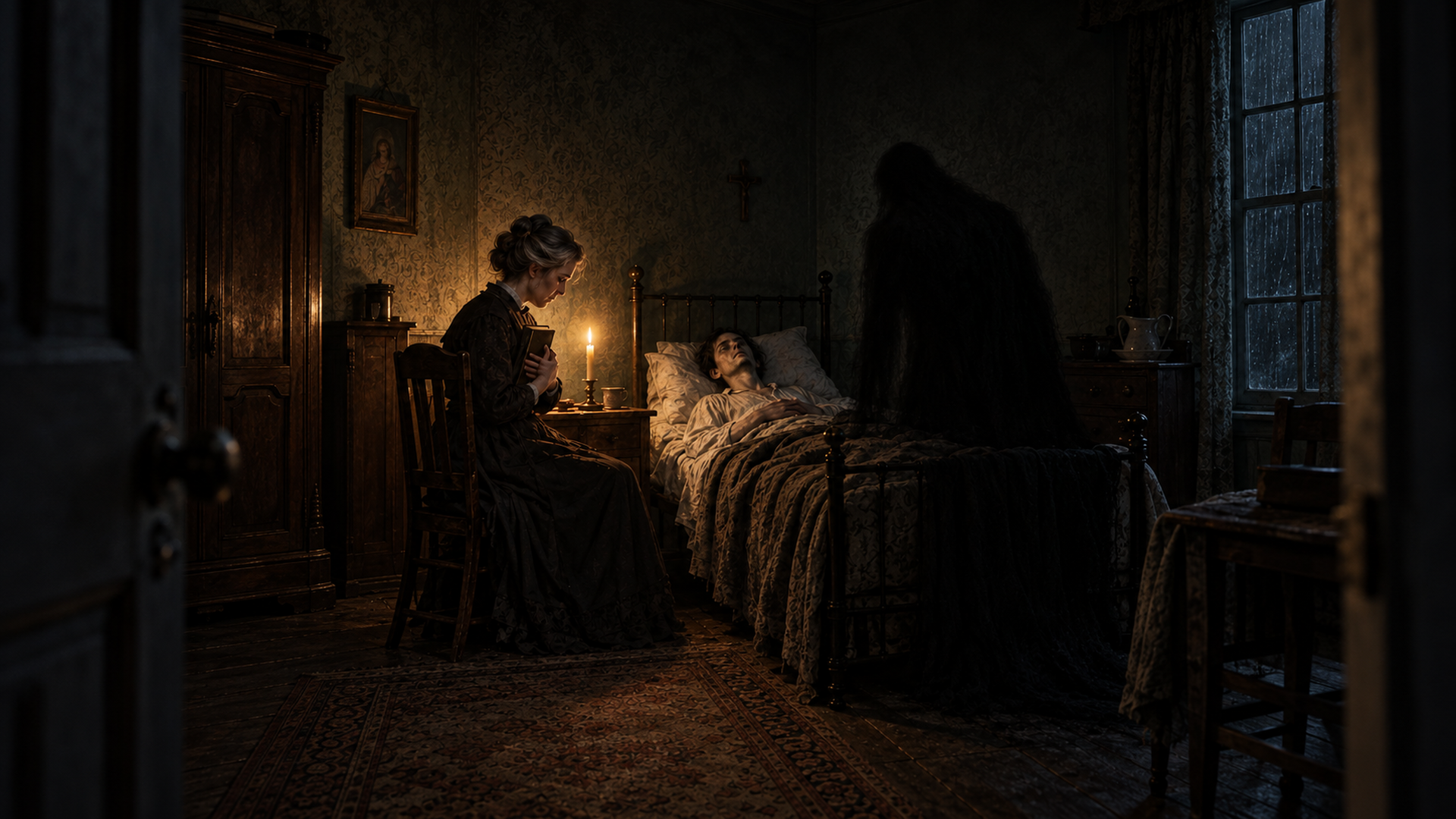
Merripen lay in bed, his skin pale and his breathing shallow. His mother pressed a cold cloth to his forehead, touched his lips with ice, spoke his name in a steady voice, and set a hymn book by his hand. The air near it seemed to grow heavier, the first sign that a presence in the room had begun paying attention. She observed his chest rise and fall, counting each breath and pause, her hand near his face, eyes fixed on his eyelids. No movement came. The priest stood at the foot of the bed and spoke the prayer in a firm voice. His words filled the room, settling by the walls, the ceiling, and the hymn book. The book stayed motionless. They stood in a circle around the bed, watching his face, his hands, the cloth on his forehead, the hymn book, never looking away. She touched the book, opened it, placed her thumb on a page, and murmured a line she had taught him as a boy. Her voice stayed steady. His health had worsened weeks earlier. He grew shaky in the kitchen, dropped a cup, and grabbed the counter with both hands. When his mother asked how he felt, he said nothing. He walked the hallway with trembling legs and blurred vision, resting against the wall to steady himself, pulling away when she reached for him. He shouted at the doctor, refused every test and medicine, and looked away when she asked him to listen. The diagnosis struck him with force. His mind broke, and soon his body followed. He lost strength, balance, and the ability to speak. He pushed everyone away, wanted no comfort and no prayer, and stayed silent, holding out for nothing. She opened the hymn book once more, turned to a different page, murmured a further line, her thumb on the printing. His eyelids did not lift. His fingers did not move. She remembered the pew, lifting him into it; his father placing the book in his hands, guiding his finger along the lines; his refusal, his silence; the mass of the book against his palm. She looked at him, then the book, then the page, and murmured the same line she had murmured once in the sanctuary. His breathing thinned. His skin grew hot. His pulse slowed. She pressed the cloth to his forehead, touched his lips with ice, spoke his name again, her hand steady. The priest stepped closer, placed his hand near Merripen's shoulder, and repeated the rite. His voice reached the book. The book stayed motionless, but the air around it had begun, for the first time since she set it down, to press back. The page gave a slight shudder. She felt it and said nothing. A presence filled the room. It did not move or speak. It pressed against the air, the walls, the ceiling, and the hymn book, the pressure gathering now in the manner a storm gathers before it breaks. Merripen's eyelids flickered. He raised his fingers a little. His breath stopped. His mother came closer, touched his cheek, murmured his name. The hymn book opened on its own, its pages moving untouched, and the pressure in the room reached its full height. A flash appeared behind his eyes. His body jerked. His mother gasped, holding the book tighter. His fingers rose from the sheet. His eyelids opened, his gaze fixed and unblinking, as his mother screamed, pressed her forehead to his, called his name in a shaking voice, and gave thanks to God, to the priest, to the room. He rose straight, steadied his breath, and asked for water, bread, and light. She brought each one, the hymn book held to her chest, and murmured a line from it, her hands steady though her voice shook. The priest moved nearer, raised his hand, and blessed the room. The book did not move. The pressure near it only increased. Merripen drank the water, ate the bread, looked at the window, the ceiling, the floor, and did not look at the hymn book, his mother's face, or the priest. She touched his arm and asked how he felt. He said he felt strong, clear, alive. She cried again, her hand to her mouth, the book held to her chest. The family moved nearer, hands on his shoulders, calling his name, giving thanks to God, to the priest, to his mother. Merripen nodded but did not smile, and said nothing further. The next morning he walked to the kitchen, steady, his mother watching every step, the hymn book held to her chest, a line murmured. He ate a full meal, stood without help, spoke easily. She touched his shoulder and the book, murmured another line. He did not respond. He did not look at it. He went into the living room and touched the back of a chair, the edge of a table, the wall. His mother observed and murmured a third line. He believed he had recovered, believed the sickness had passed, believed the flash had saved him. The hymn book lay on the table, its cover trembling faintly, and he did not see it. She opened the book again, touched a page, murmured the line she had taught him as a boy, remembering the pew, the lifting, the guiding of his finger, his refusal, his silence. She murmured it again. Merripen walked past her, past the book, past the memory. He reached the doorway, his breath catching, his vision blurring, his legs shaking, and told himself he was strong, clear, alive. He stepped into the hallway. His mother remained motionless, watching the book. Behind him, though he did not turn to see it, her legs buckled beneath her at the precise moment his own back was fully turned, a sound too soft to be called a fall, more a settling, the book slipping from her hand as she went down. Merripen walked on, his breath thinning, his pulse slowing, his skin warming, and at the end of the hall he steadied himself once more, telling himself he had recovered. He turned and saw his mother on the floor, her body twisted, her face motionless, her breathing shallow. Her hand lay near the hymn book she had dropped. The book lay open, its pages shifted, a slight pressure hanging in the air beside it. He stood in the doorway a long moment, looking at her with an intentness that held no grief. He moved nearer. The edge of the book touched his foot, the page trembling faintly, and he did not notice. He crouched beside her. Her skin was warm, her pulse weak. His thoughts ran measured and deliberate toward the house, the car, the bank account, the freedom he had already begun imagining. He lifted her arm; it fell back. He raised her head; it fell aside. He placed his hand on her chest, felt her breath rise and fall, and felt nothing himself. He dragged her into the bedroom, her head striking the floor, her arm brushing the wall, her legs catching the rug, and pulled with more force as her breathing weakened further. The hymn book rested by the door, untouched, the air around it thickening, the pressure rising, unseen by him. He lifted her onto the bed. Her head rolled to one side, her arm dropped over her stomach. He looked at her face and saw no sign of recovery, no strength, no life left in it. He stood by the bed and considered simply leaving her there, letting her die, and the ease and silence and freedom that would follow. He went to the doorway, his breath stopping, his vision blurring, his legs shaking, and told himself again that he was strong, clear, alive. He turned back. Her chest rose, then dropped. Her breathing thinned. Her fingers curled slightly against the blanket. He considered the questions others would ask, the suspicion, the trouble, the nurse, the doctor, the priest, the family, and called for help, his voice steady, reporting her collapse and asking for immediate assistance. He hung up, stood in the hallway, and listened to the silence and to her weak breathing from the bedroom, feeling nothing. The hymn book lay near the doorway, its pages spread. The air was stifling. He went back, stood near the bed, looked at her face, her hands, the blanket, the wall, and did not look at the book. She stopped breathing for a moment. Her chest tightened. Her fingers moved. Her eyes opened a little, and she looked at him, her gaze weak and glassy. He stepped back. Warmth spread across his face. His hands shook. He said nothing, moved nothing, did not touch her. The siren grew louder, closer, filling the air, rising against the walls, advancing toward the hymn book. He opened the front door. The paramedics passed him, went to the bedroom, lifted her onto the stretcher, and carried her out. He stood in the doorway, his face motionless, his thoughts slow, and witnessed none of it, held only by a faint, distant abstraction that dulled every response. * * * They took him to the ICU. The hallway hummed softly. The lights flickered. The air felt thick. His mother lay in bed, tubes attached, her chest rising and falling with the machine's pulse. A nurse spoke before she had fully opened her mouth, her words carrying a slight echo, thanking him for coming and asking him to hold his mother's hand. He did not reply. He placed his fingers on her hand. Her skin was warm, her pulse weak. He felt nothing but irritation. The machine hummed in time with his own breathing. A visitor in a familiar coat entered, set the coat on the chair, moved to the bed, touched his mother's arm, and murmured her name. It was the second time that same visitor had made that same crossing of the room since Merripen had arrived. However, no one else in the ward seemed to notice the repetition, and a part of Merripen understood, well before his mind caught up to the understanding, that the room itself had begun looping around him rather than simply repeating by coincidence. Merripen turned into the hallway, his breath catching, his legs shaking, and steadied himself, telling himself he was strong, clear, alive. He returned. The same visitor came in again, the same coat, the same chair, the same motion, the same murmur, his inscrutable expression unchanged, his eyes never once meeting Merripen's. The nurse spoke again with the same faint echo, asking him to stay near his mother, and he stepped back, heat spreading over his face. In the corner of the room stood a presence with no shape, no face, no voice, pressing against the air, the walls, the ceiling. The machine's rhythm sharpened. The lights flashed each time he blinked, whether his eyes were open or closed. On the table, the hymn book's cover trembled faintly. He did not notice. His aunt arrived, touched his mother's hand, opened the book, murmured a line. Merripen left the room in a wave of disgust, steadied himself in the hall, and returned to find his aunt yet there, on the same page, murmuring the same line, her breath unshaken. The visitor came again. The coat. The chair. The murmur. The nurse asked once more that he stay near his mother. He stepped back further. His aunt grew pale and left the room without looking back. He stood by the bed, looking at everything but the hymn book, as the visitor entered once more, set down the coat, touched his mother's arm, murmured her name, and the book's pages spread wider on their own, the room holding its breath around them. He moved toward the door, wanting only to leave. The flash struck behind his eyes the instant his hand touched the frame, the same manner it had struck him once already in his own sickbed weeks before, and he understood, in the single heartbeat before it took him, that whatever had reached into him then had never truly let go. He blinked, and the ICU was gone, replaced not by darkness but by an older, brighter room he had not stood in for over twenty years. * * * The hymn book lay close to his pillow. His mother touched it with her thumb and murmured a line, and the sound pulled him backward, into the sanctuary, into memory. He saw himself as a boy, legs dangling from the pew, his father lifting him into place, his mother opening the book and setting it in his small hands. The printing held steady on the page, the lines forming a shape he refused to follow. She guided his finger along the words, her breath at his ear, and he did not repeat what she murmured. The congregation waited. The organ began. Voices rose in the hymn. His mother and father sang. He did not. He looked at the floor, the bench, the book, and offered nothing. She pressed her thumb to the page and murmured the line again, patient, her hand resting on his shoulder. He felt the book against his palm, his mother's warmth, the congregation rising around him, the presence near the altar, and gave none of it back. His father laid a hand on the pew, looked at him, nodded, murmured the line, and waited. Merripen said nothing. A presence filled the sanctuary the same manner it had filled every room since, pressing on the air, the walls, the ceiling, the hymn book, the boy himself. He looked at the altar, the cross, the candles, the choir, his mother, and did not sing. She closed the book at last, touched his shoulder, murmured his name, and looked at him with a patience that asked for nothing back. He stared at the floor. The sanctuary held its breath. The hymn ended. The pressure eased. She tried once more, a different page, a different line, and he pulled his hand away. He sensed, even then, the shape of what he was refusing, the mass of the book, the warmth of her hand, the silence he kept building to separate them, a recollection already forming that he would spend years failing to outrun, plaintively sorrowful though he would not have called it that, since he had no word yet for what he was doing to her. * * * He felt the truth rise. He felt the cost of every silence he had ever given her. He blinked, and the ICU vanished with it, the hallway, the nurse, the visitor, the machine, the presence, the hum, the flicker, the echo, all of it gone at once. He lay in his own bed. His mother stood near him, holding his hand, the hymn book in her other palm, tears on her face, her voice steady even as her breath thinned. Family stood near the walls, the doorway, the bed, their faces strained, their hands motionless. A hospice nurse near the foot of the bed said, in a firm, measured tone, that he would pass soon, and did not look at him again. He tried to speak. His tongue would not move. His throat made only guttural sounds. His chest tightened. His skin burned. Terror filled what was left of his mind. The air thickened around his face, his chest, his throat, the hymn book, the walls, the ceiling near his pillow. His mother touched the book with her thumb, murmured a line, and the sound struck him with force, pulling him backward into the sanctuary, into the pew, into the memory he had spent his whole decaying life refusing to keep. He saw himself as a boy again. He saw his father lift him. He saw his mother open the book. He had given her nothing, not once, not ever, and he understood that now with a clarity vast enough to fill the whole immensity of the little room he was dying in. He tried to move. His body would not answer. He tried to reach for the book. His hand would not rise. A presence stood at the foot of the bed, formless, faceless, silent, pressing on the air, the hymn book, and him. The book opened on its own, its pages turning, the room dimming as the presence drew tight around them both. His mother pressed the book to his chest, murmured his name, told him she loved him, told him she was there. Her voice held. Her breath did not. He gasped. The flash struck again, filling his skull, his chest, the room, the air, the hymn book, the presence itself, until darkness followed and the pressure loosened at last. The air stilled. The room held silence. The hymn book closed. His mother lowered her head. The presence vanished. He died as he had lived, hopelessly, distraught beneath a stillness he never let anyone see, blind to mercy under some unholy influence of his own making until the veil lifted at the final moment and showed him, too late for questioning, the plain truth he had refused the whole of his life to look at.