
Read along
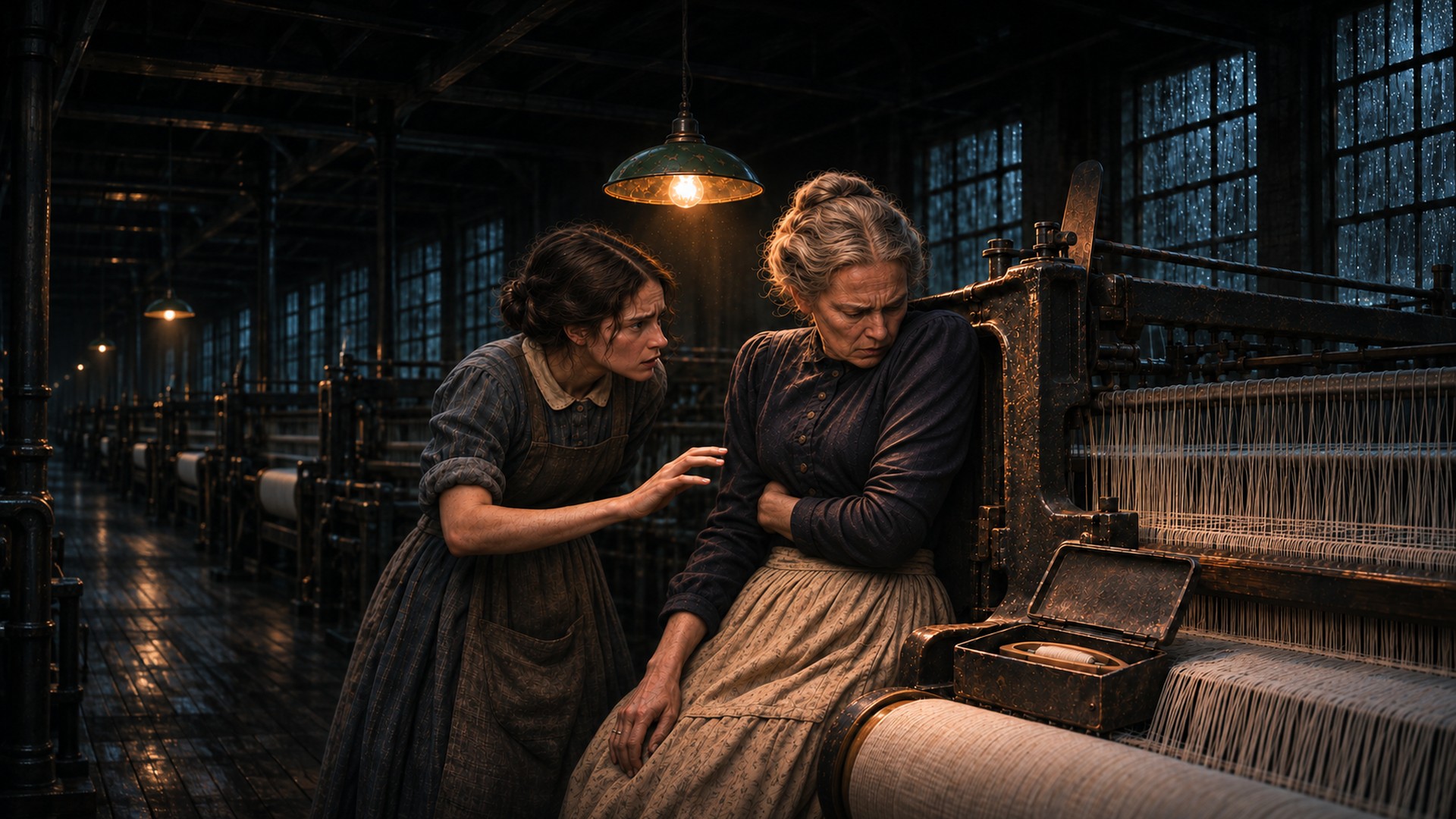
Mrs Shaw's wedding ring came out of the loom flat.
Hattie found it pressed into the new cloth while Mrs Shaw stood examining her hand. The shuttle had struck its box as she reached across it. Hattie hadn't seen whether the ring slipped before Mrs Shaw pulled away, and now the machine was stopped and everyone nearby was watching. Mrs Shaw tried to push the little plate of gold over her knuckle. Hattie made a noise halfway between a laugh and being sick.
“Fetch my purse, love. We'll have Grimes up here asking why we haven't finished the piece.”
“Does your hand hurt?”
Mrs Shaw opened it for inspection. “Just my pride. That ring's been loose since Christmas.”
September of nineteen thirty-three was a poor time to refuse a job in Lowell. Hattie Ward had spent two years winding bobbins, and the weaving job paid two dollars more a week. There were other girls who wanted it. She'd watched them watching her go upstairs, and taken care to look as though she already knew her way. In three weeks Mrs Shaw would move to her sister's house, leaving Hattie her looms.
At the office hatch on Friday, Irene Pike took thirty cents for the damaged cloth. Mrs Shaw disputed it until Irene found the stoppage report and admitted a screw had worked loose. The deduction stayed. Hattie had expected a clerk who admitted a mistake to put it right, and stood waiting even after Mrs Shaw touched her elbow.
“Come along. I'm hungry.”
“But she said…”
“I heard her. We'll speak to Grimes when he comes in. She knows how to take money out of an envelope, but never how to put it back.”
Hattie followed her upstairs, still working out what she ought to have said.
The rent notice lay under the sugar bowl at home. Her mother had set the bowl over the figure owed, leaving the landlord's request for prompt attention where they could both read it during supper. Across the canal another mill was running late, and Hattie had to ask her mother to repeat herself.
“Will you get the extra money this week?”
“When Mrs Shaw leaves.”
“Well, I hope she enjoys a good rest.”
Her mother had been unpicking a badly sewn cuff for a customer whose shirt cost more than their coal. Hattie wanted to tell her to leave it. Next week perhaps she could, but Hattie would earn the extra two dollars only if the mill ran a full week, and nobody had worked one since July.
Mrs Shaw made her use a thread hook whose wooden handle had been wrapped in string. Hattie found it awkward. She could reach a snarl faster with her fingers, and said so during the dinner stoppage.
“You'll get quick with it. Mind Grimes doesn't borrow it. He held it backward last week and stood there telling me what to do.”
She'd bought the hook after a cloth beam fell and trapped her against the frame. Two men had lifted the beam while a third cut her apron away.
“You were under it?”
“Apron was. I thought my arm was caught, too, but I must've been wrong. Anyway, I've had enough reaching into these things.”
On Monday Hattie stopped a loom to clear waste from the shuttle box. She left the hook on the next frame because she needed only a second, and the iron cover fell onto her right ring finger.
For a while she was occupied with the business of getting loose. She lifted the cover with her left hand, but the hinge had dropped crooked and jammed. Her finger stayed under it. She could see the tip beyond the edge, already turning white.
Mrs Shaw was two looms away with her back turned. Hattie called, and called again. The other looms rattled so hard she couldn't judge how loudly she was speaking.
She leaned forward to get a better grip. Her sleeve brushed the belt turning beside the frame. She drew her elbow in, carefully, and saw how close she'd brought her hair to the same belt. She'd pinned it up that morning. She remembered complaining to her mother about the pins.
Now she wanted her mother to come and get her.
When Mrs Shaw finally turned, Hattie was trying to tear the finger out. Mrs Shaw caught her wrist and shouted directly into her ear.
“Leave it alone. I'll lift it.”
Mrs Shaw fetched the thread hook from the next frame, slipped it under the jammed cover and pried it up. Hattie's nail had scraped against the iron. She couldn't feel much beyond the joint, but the finger bent when Mrs Shaw asked her to bend it, and the floor man said she'd been lucky.
She sat on an upturned box until her legs would hold her. Mrs Shaw stayed beside her, though two looms stood idle and Grimes would have something to say about it.
Downstairs, Irene asked which hand, which finger, whether Hattie needed a doctor. Behind the clerk's shoulder the wage book lay open to a page of hours and deductions. Hattie thought about the rent.
“I can finish.”
“Then go back upstairs.”
Irene began writing before Hattie had left the hatch. Hattie waited for a charge to be mentioned. When none was, she went back up quickly.
That afternoon Grimes told Ada Finch her sack mending would finish at the end of the following week. Ada asked to return to weaving. Grimes looked at her swollen knuckles and asked how many looms she expected to manage.
“I managed six before you put me down here.”
“Before,” Grimes said. He pulled a repaired sack off the pile, examined the seam and left it for someone to carry away.
Hattie had come down for a sack to hold loom waste. She asked Grimes to give Ada some of Mrs Shaw's looms when Mrs Shaw left. Grimes said the purpose was to remove a wage, then walked away while Ada was still explaining that the sacks would require mending whoever sat there.
Hattie tried asking whether Ada had anyone she could stay with. Ada said she wasn't ready to be put away.
“My aunt lived nine years after she finished weaving. I'm supposed to spend nine years eating somebody else's bread?”
Hattie hadn't meant that, and apologized. She looked at Ada's swollen knuckles. If her hands couldn't manage the looms, Hattie couldn't see how they would last another nine years pulling a needle through sacks.
Mrs Shaw took Hattie back to the hatch on Wednesday. Grimes was inside, inspecting the week's figures. He agreed to cancel the spoiled-cloth charge and immediately pointed out a deduction for the time Mrs Shaw had spent teaching.
“You asked me to teach her,” Mrs Shaw said.
“Instruction reduces output.”
“I'm not paying to train the girl you picked.”
Irene corrected the instruction entry. Grimes slid a receipt under the hatch and told Mrs Shaw to sign for her final settlement.
“There's no sum on it.”
“It'll save coming back.”
“I've been coming here thirty-one years. I can manage another trip.”
She left the receipt lying there. Hattie followed her upstairs, pleased enough with the returned thirty cents to tell the story twice before dinner.
On Thursday the mill posted three days for the following week. Even at the new rate Hattie would bring home less than she did winding bobbins. At supper her mother pointed to the uneaten bread in Hattie's pail and asked if Mrs Shaw had fed her again. Hattie became angry before she could help it.
“You keep bringing yours home,” her mother said. “I'm glad somebody's feeding you.”
The mill had stopped at six, yet Hattie still heard its uneven knocking while they ate. She imagined telling her mother about the finger, or the layoff, and being watched every morning afterward. Instead she talked about the sister's house. Mrs Shaw would have her own bedroom, and a washstand with a jug that belonged to her. Hattie had asked about that twice, though she'd tried to make the second question sound different.
During their last full day together, Mrs Shaw made Hattie run the looms while she stood back. Hattie kept turning to ask a question and finding the answer in the woman's face before she'd asked it. She dreaded doing this without her. She also caught herself calculating the money she would lose if Mrs Shaw changed her mind.
At dinner Mrs Shaw read part of a letter from her sister. There were two neighbors with sewing for her, and a little patch at the back where she'd been promised she could grow beans.
“She says I've to rest the whole first week. I'll have to go round pulling out her mending when she's asleep.”
Hattie smiled. She wanted the sister to be waiting exactly as described.
At the washbasin afterward, Hattie noticed a band of discoloration across Mrs Shaw's left forearm. It might have come from the dye on a piece of cloth, except Mrs Shaw was rubbing it with soap and it wouldn't wash away.
“Must've knocked myself.”
She turned her arm under the tap, searching for a tender place. Hattie remembered the fallen beam and asked whether it had left a mark there.
“Never left anything. That's why they said it missed.”
Mrs Shaw shut off the tap. With the machines stopped for dinner, the dripping carried across the little washroom.
“Does it hurt now?”
Mrs Shaw shook her head, and Hattie went back to work hoping she'd forget to ask again.
On Friday Mrs Shaw brought bread with butter folded inside and said she'd already packed her work apron, which meant Hattie would have to lend her one. Hattie lent it without mentioning that her mother had made it from a skirt and would recognize every new stain.
They ate on the stairs before the starting whistle. Mrs Shaw had her sister's address written inside her purse in case she muddled the street after getting off the car. She made Hattie promise to visit.
“If the old women begin telling you I did twice as much in half the time, come and complain. I want to hear what a marvel I was.”
When Mrs Shaw broke the bread, Hattie saw a crease around her ring finger. She remembered the flattened gold and wanted to examine the hand. Instead she asked whether the jeweler had looked at the ring.
“My sister knows a man.”
Mrs Shaw was holding the bread in her lap now, watching her own finger. She pulled at the crease with her thumb.
“That's queer,” she said, and covered her hand when the whistle sounded.
The morning's work went badly. Hattie missed a broken thread, and a length of spoiled cloth wound onto the beam before Mrs Shaw caught it. Grimes came over and asked whether Hattie intended to start her new job by costing him money.
Mrs Shaw put herself between him and the cloth.
“She was attending the other looms you gave her.”
Grimes looked at the clock. “You need to be downstairs before noon, Mrs Shaw. Your envelope's ready.”
“When I've put this right.”
“That's your time, then.”
Hattie wished Mrs Shaw would take her pay and go. Hattie could manage the repair. She could stand being made to pay for it, too, if only the woman would stop rubbing that finger against the seam of her apron.
Shortly before noon the gatekeeper came to fetch Mrs Shaw. She had the loom stopped, drawing a tangle out with the hook, and said she'd finish the job she'd begun. He waited by the window, beating dust from his cap against his leg.
Hattie asked if he'd known Ada's aunt.
“For years. Had to help her up the stairs toward the end.”
“Ada says she lived nine years after she gave up.”
“Gave up weaving. She did sacks after that. Ada took her place.”
Hattie glanced toward the stairs.
“Then she was still earning?”
“Until the Friday she finished. Went down for her envelope and dropped in front of the hatch. Never collected it.”
He looked at Mrs Shaw's coat hanging from a peg and called to her again.
The room began shutting down for dinner. Mrs Shaw caught the last loop of thread and pulled it clear, holding the hook out for Hattie to take.
Then she looked down at her sleeve.
The cloth drew tight across her left forearm. Her elbow came toward her ribs and kept going until her shoulder was pressed against the frame.
“Help me a minute.”
Hattie put the hook down and reached for her. There must be cloth caught round Mrs Shaw's arm. She bent to find it, annoyed with herself for being frightened of a snag.
Mrs Shaw screamed directly above her head.
Her forearm had flattened beneath the sleeve. Hattie had been holding that arm when it changed, and she kept holding it, although the bones were moving against her fingers. She couldn't find enough breath to call for help.
Mrs Shaw's left hand opened. The ring finger bent sideways and passed beneath the little finger.
“Get it out,” Mrs Shaw said.
The shuttle sat in its box beyond her hand. Hattie could have put her whole fist between them.
The gatekeeper took Mrs Shaw under the shoulders and tried to lift her away. She came away from the frame easily. Her arm stayed driven against her chest. He laid her on the floor and got down beside her, asking what had caught her.
“Beam,” Mrs Shaw said.
Hattie looked at the beam resting on its supports.
She pulled up Mrs Shaw's sleeve. The skin split across the bruise. Hattie pressed her apron over it and felt a bone come through. She took her hand away, then put it back before Mrs Shaw could see.
Mrs Shaw tried to speak again. Her ribs lifted against the trapped arm and fell back without a breath. With the looms stopped, Hattie could hear every effort she made. Hattie knelt where Mrs Shaw could see her and said somebody was coming, somebody would get it off, while the woman's good hand tore at Hattie's dress.
The gatekeeper called for a doctor. Hattie was already running.
Irene was alone in the office. Hattie shouted through the hatch for the telephone, then saw the line ruled across Mrs Shaw's account.
“She's still upstairs?” Irene said.
Hattie hadn't told her who needed help.
“What have you done?”
Irene looked toward the stairs and reached for the telephone. Hattie pushed into the office while she was giving the address.
Beside the wage figures was a column headed Carried. Mrs Shaw's name filled several lines. Hattie read “beam, left forearm, chest” in Irene's neat hand, and below it the date of the ring accident.
The next account was her own. Right fourth finger.
Irene set down the telephone.
“Put her back,” Hattie said.
“It doesn't work after the account's closed.”
“You haven't even paid her.”
“Grimes said noon. She was supposed to come down.”
Hattie could hear the gatekeeper calling from above. She heard the panic in his voice and tried not to make out the words.
“Those things never hurt her.”
“While she works here, the room keeps them. Everything that happens at the looms.”
“And then?”
Irene looked at Mrs Shaw's entries. Hattie wanted to take the clerk by the hair and beat that calm face against the desk. They'd let the woman plan her room, write to her sister, stand here arguing over thirty cents.
“All of it when she leaves,” Irene said. “There's no money you can pay instead.”
“Can somebody else carry it?”
Irene kept her eyes on the page. Hattie reached for the pen.
“Somebody still weaving in that room,” Irene said. “You'd have to keep working here. Yours and hers. If you're dismissed, or the mill closes, it all comes due. Her arm won't be mended by it.”
A woman upstairs was counting aloud, asking Mrs Shaw to breathe between the numbers.
Hattie thought of her mother trying to find the rent with Hattie in a grave. That stopped her longer than fear for herself. She looked down at her right hand, which had already been entered in the book.
“How much have I got?”
“Enough to lose that finger.”
From upstairs came a sound Hattie had never heard a person make. She dipped the pen. Irene turned the book toward her, and Hattie wrote her name beneath Mrs Shaw's.
As she finished, pressure closed round her left arm. She bent over the desk, waiting for it to break.
Then she could straighten.
Above them somebody said Mrs Shaw was breathing.
Mrs Shaw lost the arm below the elbow. Hattie went to see her on Sunday, and for a while they discussed the sister's house because neither could manage anything else. A cart rattled across the hospital yard. Mrs Shaw turned her head toward it.
The wheels clattered like looms starting up.
“Are they starting?”
“It's Sunday.”
“I know what day it is.”
Hattie told her about the book.
Mrs Shaw listened, then asked whether Hattie had understood what she was signing. Hattie said she had. The woman looked away.
“You should've left me,” Mrs Shaw said.
Hattie had known she would say that, and found she couldn't bear to hear it anyway. She stayed until visiting ended. Mrs Shaw asked her to come again before she went to her sister's.
Hattie told Ada before Monday's shift, and stood beside her while she demanded to keep the sack work. By then the women upstairs had seen the blood under the loom. Grimes agreed to keep her at half pay. Ada accepted before he finished speaking.
The weaving room had women old enough to be Hattie's grandmother, all standing at their frames with usable hands. Hattie had admired that when she first came upstairs. Now she watched how carefully they followed Grimes with their eyes.
She told her mother that night. Her mother asked what would happen if Hattie were sick and missed work.
“He'd have to keep me on.”
“Would he?”
Hattie thought of Ada accepting half wages beside her pile of finished sacks, and couldn't say he would.
At the next shift the floor man pointed out a loose fitting on Hattie's fourth loom, and she stood over him until he had it tightened. The revised schedule hung beside the hatch, and she checked it again before going upstairs, looking for another day crossed out.
Hattie put the hook in her pocket and started the loom, already trying to work out how she would get up the stairs on the morning her legs gave out.