Read along
In my subterranean workshop beneath the salt-rotted rafters of the old Boston Maritime Museum, I uncrate the carcass that is supposed to save my life.
The air down here always smells of old iron, damp granite, and the sharp, vinegar sting of my tanning liquors. Above me, three feet of timber and brick muffle the tide sloshing against the harbor wall, turning the crash of the ocean into a slow, rhythmic thud. A lonely vault, perfect for a disgraced taxidermist whose academic reputation was stripped away by bitter colleagues five years ago. They called my methods archaic. They called my theories on biological tissue restoration grotesque. But tonight, on the zinc-topped workbench in the center of the room, sits a heavy, steel-ribbed vat that could silence every critic from Cambridge to London.
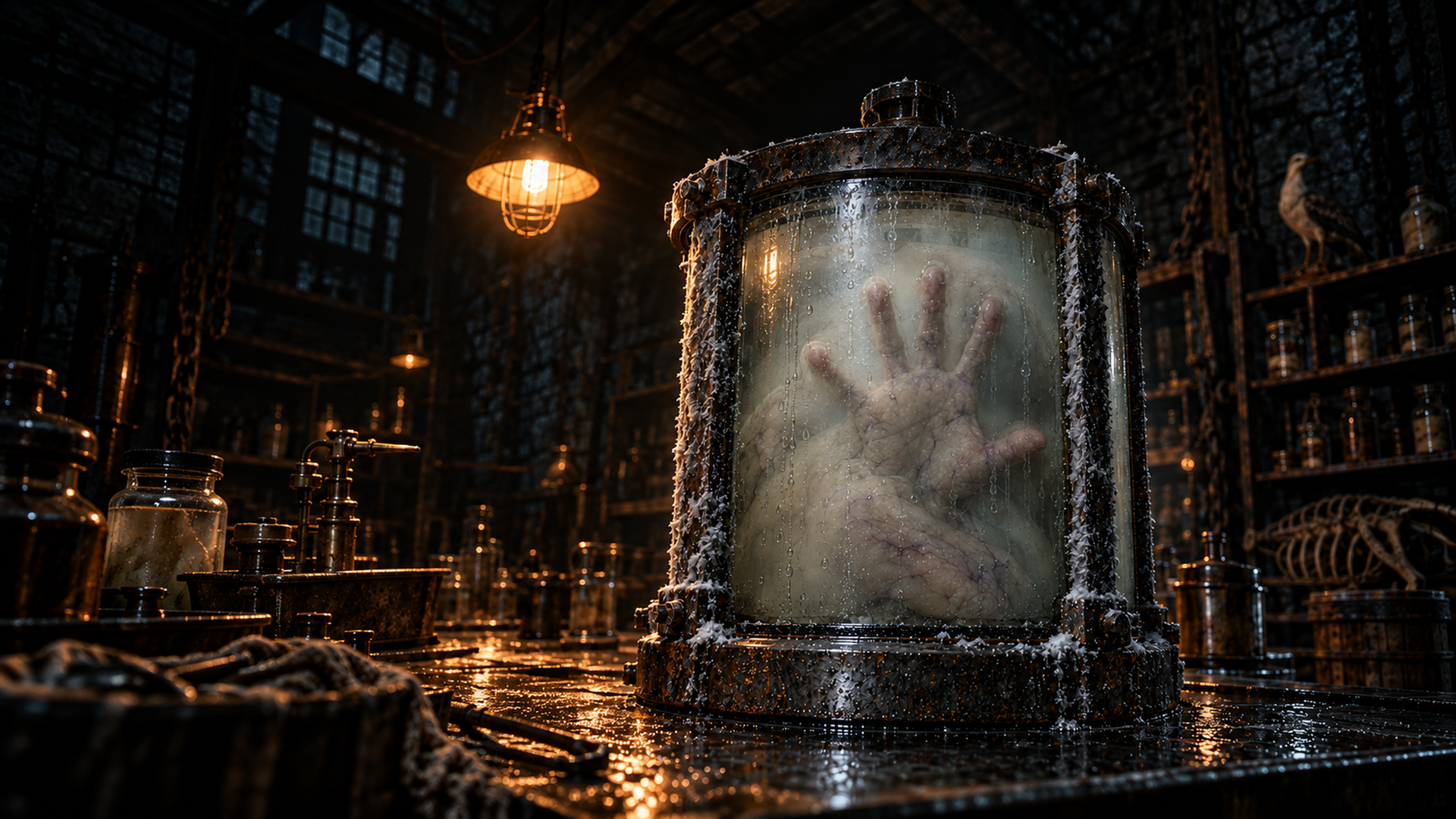
The crate arrived at midnight on a flatbed truck without license plates, left on the damp cobbles of the alleyway. Insulated with dense foam, sealed with cold rivet heads, and wrapped in industrial banding that screamed under the teeth of my wire cutters. Inside sits a cylindrical tank of thick glass, submerged in a milky preservation brine.
Through the clouded fluid, I can see the specimen.
The carcass is a pale, unformed mass of deep-sea flesh, roughly the size of a folded sheepskin. It possesses no obvious eyes, no recognizable jaw, and no fins. A convoluted wad of gray, rubbery folds, marbled with faint violet veins that spider across its damp expanse. The shipping broker’s encrypted note promised an unclassified abyssal specimen, pulled from a thermal vent five miles down in the North Atlantic basin. A creature like this, unmapped and biologically anomalous, is worth a fortune. A paper on its skin density alone will put my name back in the journals.
I reach for my brass calipers and my iron scraper. My hands are steady, though my lungs feel heavy in the cellar air. I take a deep breath of formalin, lean over the glass rim of the open tank, and prepare to siphon off the top layer of transport brine.
As I step within arm's reach of the open vat, a sudden, fierce heat flares in my lower back.
This is no muscular spasm. A deep itch burns inside the jagged surgical scar that has marred my spine since infancy. My parents always told me the mark was the result of a corrective operation for spina bifida, leaving me with a dull ache that no opiate could deaden. But right now, the scar burns. A thin, cold needle twists inside my lumbar spine, stirring nerve roots dry and useless for thirty-four years.
I pause, resting my elbow on the lip of the zinc table. The bone-deep heat in my back swells, radiating toward my hip bones in hot waves. The sensation pulls my spine toward the center of the vat. I grit my teeth, shifting my weight to my left leg. I am a man of science, a master of flesh and bone, not a child frightened by tremors in a cold basement.
I lower my face closer to the rim of the vat, adjusting the gooseneck lamp above the specimen. The bright halogen light shines through the milky liquid onto the leathery gray hide.
Then, deep under the formaldehyde brine, the specimen twitches.
A folded flap of gray flesh hitches upward, contracting twice in a tight shudder before sinking back into the murky fluid.
I freeze, my fingers tightening around the edge of the zinc table until my knuckles ache. Air bubbles rise from the creature’s central folds, popping on the surface of the brine with a soft hiss. A living specimen? No, that is impossible. No organism can survive submerged in concentrated formaldehyde. A lingering muscular spasm, an involuntary chemical reflex triggered by sudden exposure to light and oxygen. Deep-sea fauna possess dense nervous systems built to withstand immense pressure.
I clear my throat, forcing the tension from my shoulders, and turn my attention to the manifest binder stapled to the transport crate.
I need to know the exact chemical composition of the transport brine before I begin scoring the tissue for tanning. I slice through the plastic sleeve with my thumb-scalpel and pull out the laminated ledger sheets. I expect standard oceanographic data: salinity percentages, depth logs, pressure seals from a deep-sea trawler operating off the Grand Banks.
Instead, the top header reads: *Aetheria Cryo-Vaults, Boston Facility.*
I frown, running a thumb over the crisp blue ink. There is no ship registry listed. No sea captain’s mark. The dispatch address is a commercial street in South Boston, barely four miles away.
I turn to the fluid analysis sheet. The preservation liquid isn't salt-dense ocean water. The chemical readout lists a mixture of lipid-rich synthetic blood plasma, buffered against rapid autolysis by osmotic stabilizers. The fluid has been custom-mixed to match human tissue suspension parameters, designed not to freeze a sea creature, but to keep mammalian protein structures alive at sub-zero temperatures.
I stare at the page, my mind racing through my anatomical study. A deep-sea organism preserved in human-compatible plasma? I shake my head, a cold smile touching my lips. An aggressive evolutionary mechanism. Benthic fauna surviving in extreme environments often possess cellular camouflage capable of altering osmotic pressure and protein bonds to mirror whatever organic mass it encounters. The researchers who harvested this specimen must have used a synthetic mammalian serum to fool its predatory defenses during transit. A brilliant, terrifying piece of bio-engineering.
The heat in my spine flares again, pulling a gasping breath from my throat. The itch has spread, tracing my sciatic nerves down into my thighs. My back muscles tauten against my canvas apron.
I ignore the pain. I grab my long-handled scalpel, a heavy brass tool with a razor-sharp belly, and lean over the vat. I need a tissue sample from the edge of the main skin mass to test its cellular density against my alum tanning solution.
I reach into the fluid with my steel forceps, clamping down on a folded margin of gray hide. The tissue is surprisingly dense, resisting the steel teeth like boiled leather. I bring the scalpel down, applying steady pressure to score the outer layer.
The skin is far tougher than I anticipated. The blade skitters off the slick curve of the hide.
My hand slips.
The scalpel blade slices deep into the palm of my left hand, cutting clean through my leather work glove and into the muscle of my thumb. I pull back with a sharp curse, dropping the scalpel onto the wet concrete.
Blood wells instantly from my hand, bright crimson. Before I can bind the wound with my apron tail, three heavy drops fall from my palm, cutting through the milky brine and landing directly on the exposed gray mass below.
The specimen reacts instantly.
It doesn't bleed or dissolve. The moment my blood touches the gray skin, the specimen's tissue turns bright red, soaking up the droplets. The milky fluid around the mass churns as the tissue expands, swelling violently. Right where my blood landed, the rough hide dissolves, and a smooth patch of human skin erupts. It spreads outward in a rapid, wet blossom, sprouting epidermoid cells, pore networks, and fine human hairs that quiver in the light.
A low, continuous hum rises from the bottom of the vat, vibrating at a frequency so deep I feel it in my teeth. The brine ripples in concentric circles around the newly sprouted human flesh.
My breath catches in my throat. I lean over the tank, my bleeding hand trembling against my chest. The sight defies every law of comparative anatomy I have ever taught. The patch of pale skin on the specimen’s flank expands, spidered with fine capillary webs that pulse in time with the deep, wet hum from the vat.
An anatomical miracle.
Without thinking, driven by curiosity, I reach my bare hand into the cold brine. I extend my left thumb, pressing the pad of my skin against the soft human patch on the specimen’s flank.
The moment our flesh meets, the temperature of the water vanishes.
An electric shock shoots up my arm, bursting behind my eyes in a flash of white light. The pale tissue beneath my thumb feels like my own skin. It is warm, soft, and vibrating with intimate familiarity.
Then comes the trap.
The specimen's surface layer liquefies beneath my thumb, wrapping around my digit like resin. Thread-like tendrils wriggle beneath my thumbnail, driving into my nail bed and fusing with my capillaries. The tissue contracts, pulling my hand down into the vat with mechanical strength.
"No!" I bark into the empty cellar.
I plant my feet against the base of the zinc table and haul myself backward. The suction is absolute. The tissue eats into my thumb, stitching its cellular walls into my flesh. I feel its pulse traveling up the bone of my arm.
With a guttural roar, I yank my arm back.
*Tear.*
A sickening ripping sound echoes through the basement. I tumble backward onto the concrete floor, crashing against my timber tool chest. Pain explodes through my left hand. I pull my arm to my chest, gasping for air.
My left thumb is stripped to the raw dermis. The outer layer of skin and thumbnail have been peeled completely away, left behind in the vat.
I lie on the cold floor, cradling my mangled hand, watching the tank. Attached to the specimen's side, my ripped thumb tissue twitches. The specimen absorbs it, weaving my torn skin into its structure, smoothing the join until it is invisible. The pale human patch covers nearly a third of the gray hide.
I brace myself against the tool chest, preparing to drag my body up to reach the medical kit. I wait for the wave of agony that follows physical shock. I wait for the grinding in my lower back, the crippling lumbar pain that has dictated every waking hour of my adult life.
It doesn't come.
I freeze, my hands pressing into damp concrete.
The chronic ache in my spine is gone.
My lower back feels light, fluid, and entirely free of tension. During those three seconds when my flesh was locked to the specimen, the friction in my vertebrae vanished. I draw a deep breath, feeling my lungs expand without the sharp nerve pain that usually catches in my ribs.
I stand up slowly, resting my weight on both feet. The relief is so absolute that a shaky laugh escapes my lips. My thumb is a weeping ruin, but my back feels unbroken.
I take a step away from the workbench, moving toward the stairs to fetch a bandage.
The moment I take three steps back, the spinal pain returns.
It hits like a sledgehammer to the base of my skull. I collapse to my knees with a breathless scream, my forearms slamming into the floorboards. The agony is ten times worse, a searing hook embedded in my lower spine, pulling me toward the workbench. My nerve endings thrash against my bones.
The itch has turned into a biological compulsion. A ravenous hunger sits inside my skeletal frame, aching to close the distance between my body and the table.
I lift my head, my breath coming in whistling gasps.
From the workbench, a new sound cuts through the silence.
A whispering respiration. The specimen is breathing. A rhythmic air intake hisses softly through the formalin-soaked air. *In. Out. In. Out.*
I crawl to my feet, dragging my body toward the workbench. The moment I slide within two feet of the vat, the pressure in my back subsides into a warm throb. The relief is instantaneous.
I need to know what this thing is.
With my good hand, I grab a bone scraper and haul the document pouch toward me. My left hand drips blood onto the zinc top. I use the tip of the scraper to slash open the heavy canvas pouch, dumping its contents onto the metal surface.
A leather-bound medical ledger tumbles out, marked with faded red wax seals from a defunct surgical clinic in South Boston. The pages are yellowed and dry.
I flip through the records, my bleeding fingers staining the paper with red thumbprints. I skip past chemical formulas and vault rental receipts, searching for the original intake manifest from thirty-four years ago.
I find it on the final page, dated six days after my birth.
The clinic intake sheet lists two patients. Patient A: Julian Croft. Infant male. Retained for spinal reconstruction following surgical separation. Patient B: Unnamed mass. Vestigial parasitic twin.
My blood turns to ice. The room tilts, and the sound of the ocean above stretches into a flat, heavy roar.
I read the faded handwriting line by line. The record details an asymmetrical parasitic twin that grew inside my mother’s womb, devoid of a brain, heart, or limbs, but integrated into my central nervous system. Its tissue wrapped around my lumbar spine, its nerve trunks splicing directly into my spinal cord, sharing my blood supply, my skin cells, and my neural pathways.
The surgeons cut it away to save my life. But they couldn't destroy it. The parasitic mass possessed an immortal cellular vitality; it refused to decay, feeding on synthetic nutrients supplied by the clinic's research division.
My parents paid a fortune to keep the excised tissue alive in cryogenic storage, paying annual fees long after they died, leaving behind a trust that ran out of funds three days ago.
The shipping manifest wasn't a mistake. It was delivered to the only living biological match on Earth.
The twin hadn't twitched out of reflex. It hadn't absorbed my blood because it was a predator.
It recognized me.
The realization crashes through my mind. The lifelong, debilitating ache wasn't phantom nerve pain; it was an open neurological socket, a severed cable reaching out through the empty air, searching for the piece of myself that had been stolen and locked in a dark room.
The itch in my back reaches a fever pitch, shaking my entire frame. My spine feels hollow, an empty channel aching to be filled.
I turn slowly toward the vat.
The mass inside has changed. Having fed on my blood and skin, it fills the glass cylinder. Pink folds of human skin overlay the gray hide. Blue veins pulse beneath its damp surface, beating in rhythm with my own throat.
It reaches over the rim of the tank. Soft tendrils of pale flesh spill over the glass edge, sloshing onto the workbench, creeping toward me.
The whispering respiration fills the cellar. The specimen is no longer just breathing. It is calling. A silent siren song echoes through my marrow, vibrating along every nerve pathway.
*Come back.*
I don't reach for my scalpel. I don't reach for my tanning salts. I drop the medical ledger onto the floor, letting the pages scatter into the dust.
I tear off my leather apron. I unbutton my shirt, pulling the cloth free, exposing my chest and my back to the cold cellar air.
I turn my back to the workbench.
The searing heat in my lumbar spine is overwhelming, a bonfire at the base of my central nervous system. My body tilts backward, pulled by a gravitational force I no longer fight. The zinc edge presses against my thighs.
I take one last breath of formalin-laced air. I close my eyes.
And I lean backward, pressing my open spinal scar directly into the waiting mass of living tissue.
The contact is instantaneous.
A high, breathless gasp escapes my lungs, echoing off wet granite walls.
The specimen does not attack. It dissolves against my back, turning into a warm liquid that floods my lumbar region. The pale tendrils enter my skin. They slide through the scar, finding the severed ends of my childhood nerve roots and locking onto them with biological precision.
*Snap. Click. Fuse.*
I hear my vertebrae shift, sliding open to receive the tissue. Deep inside my spinal column, millions of dormant nerve endings flare to life, blinding my mind with sensory data.
I fall backward onto the table, my head snapping against the metal surface, my legs kicking out as the mass surges over me.
Sheets of human skin crawl over my hips, binding my waist to the workbench. Vascular tendrils wrap around my ribs, sinking deep between my bones, threading through my muscles, weaving into my circulatory system. A second, heavier pulse picks up at the base of my spine, driving warm blood up toward my neck.
Pain and euphoria burn through my body in alternating waves.
The pale skin spreads up my torso, covering my stomach, my chest, my shoulders. My own skin melts into the twin's flesh, erasing the boundaries between where Julian Croft ends and the specimen begins. The scar on my back is gone—smoothed over, filled with muscle and nerve tissue that pulls my posture straight.
My eyes dim as the tissue creeps over my throat, soothing the strain in my muscles. Threads of biological wire thread into my brainstem, sharing my thoughts, my memories, my breath.
I can no longer feel my fingers as separate hands. I can no longer feel my legs as separate limbs. I am expanding. I am filling the cellar. The heavy thud of the ocean tide above us no longer sounds distant; it sounds like the sloshing of brine inside our own shared veins.
I lie on the zinc table, completely encased in warm, throbbing, living skin. My human tongue grows heavy, still, and dry inside my jaw, but I do not need it to speak anymore.
Deep within the dark, wet center of our joined spine, two minds fuse into one quiet, endless whisper.
We are no longer broken. We are no longer cold. We are whole.