Read along
The yellow line isn’t there to guide you home; it’s there to keep what’s underneath from waking up. For twenty-four years, I’ve sat in the vibrating, grease-slicked cabin of this heavy-duty paint truck, listening to the monotonous, wet *hiss-splat* of the pressurized nozzles laying down highway stripes. The air inside the cab is a thick, choking soup of old tobacco, unwashed denim, and hot diesel oil. Tonight, though, there’s something else cutting through the familiar stench. It’s a sharp, chemical bite that makes the back of my throat itch—a heavy, suffocating smell of sulfur and coarse rock salt.
That’s the government-mandated Formula-9 paint. The dispatcher at the district office, a man whose voice usually has all the warmth of a gravel pit, was nearly shouting when he handed me the route sheet. He told me that standard highway yellow wouldn't cut it tonight. He insisted that if I didn't use this specific batch, if I ran out of Formula-9 before finishing the sweep of Route 99, the asphalt wouldn't hold. I didn't care about his warnings then. I only cared about the grease-stained postcard tucked into the sun visor above my head. It’s a faded picture of a diner in Oregon, sent five years ago by my daughter, Sarah. Her handwriting is jagged, cut deep into the cardstock: *Are you going to make it this time, Dad, or is the asphalt your real family?* I’ve missed her high school graduation, her college move-in day, and a dozen birthdays. Next week is her wedding. This run was supposed to be my last. A quiet, stubborn pride in my mundane labor had kept me on these dark roads for decades, but my body is tired, aching like a rusted leaf spring. I just wanted to paint the line, sign the logbook, and finally go home.
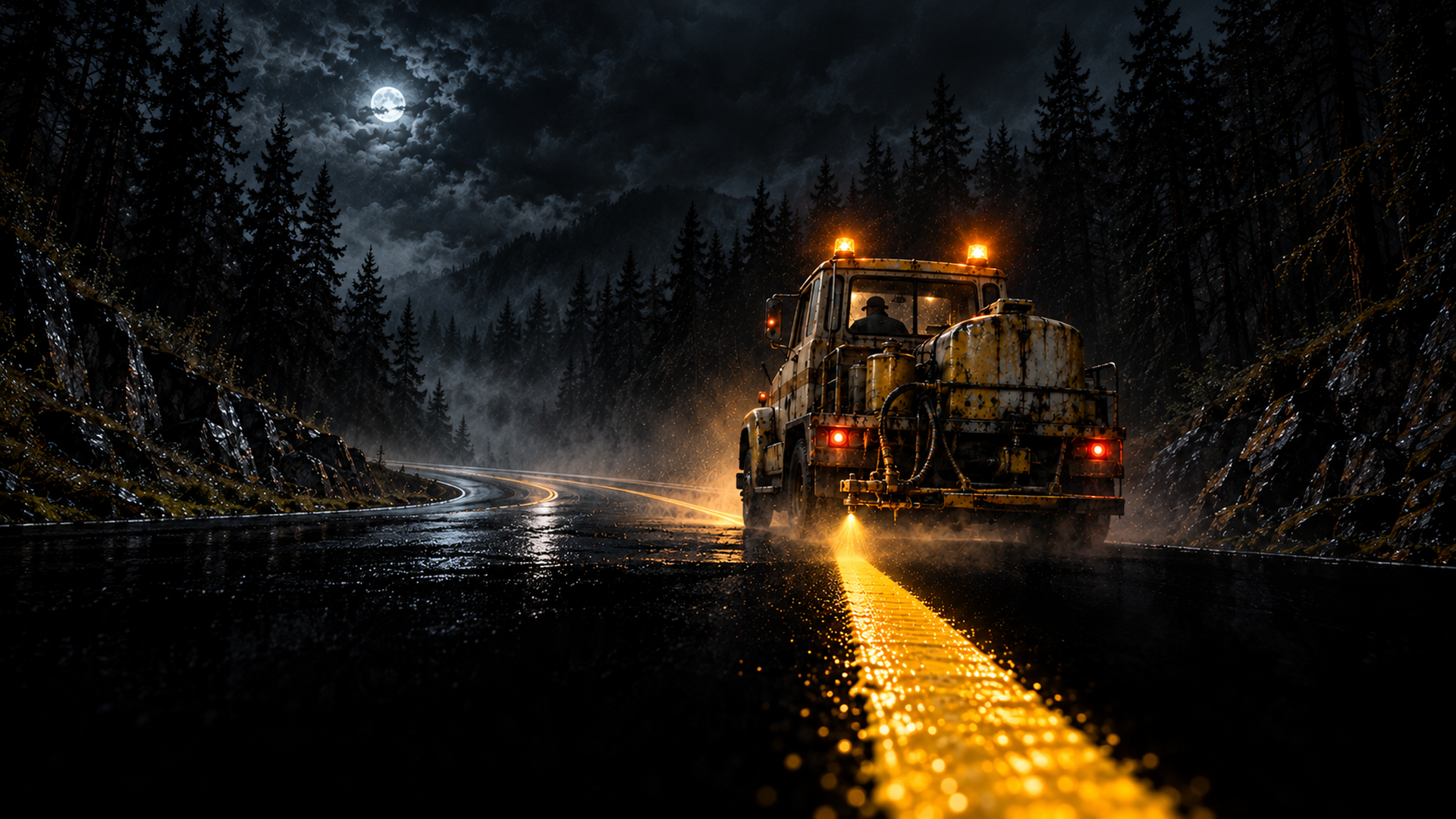
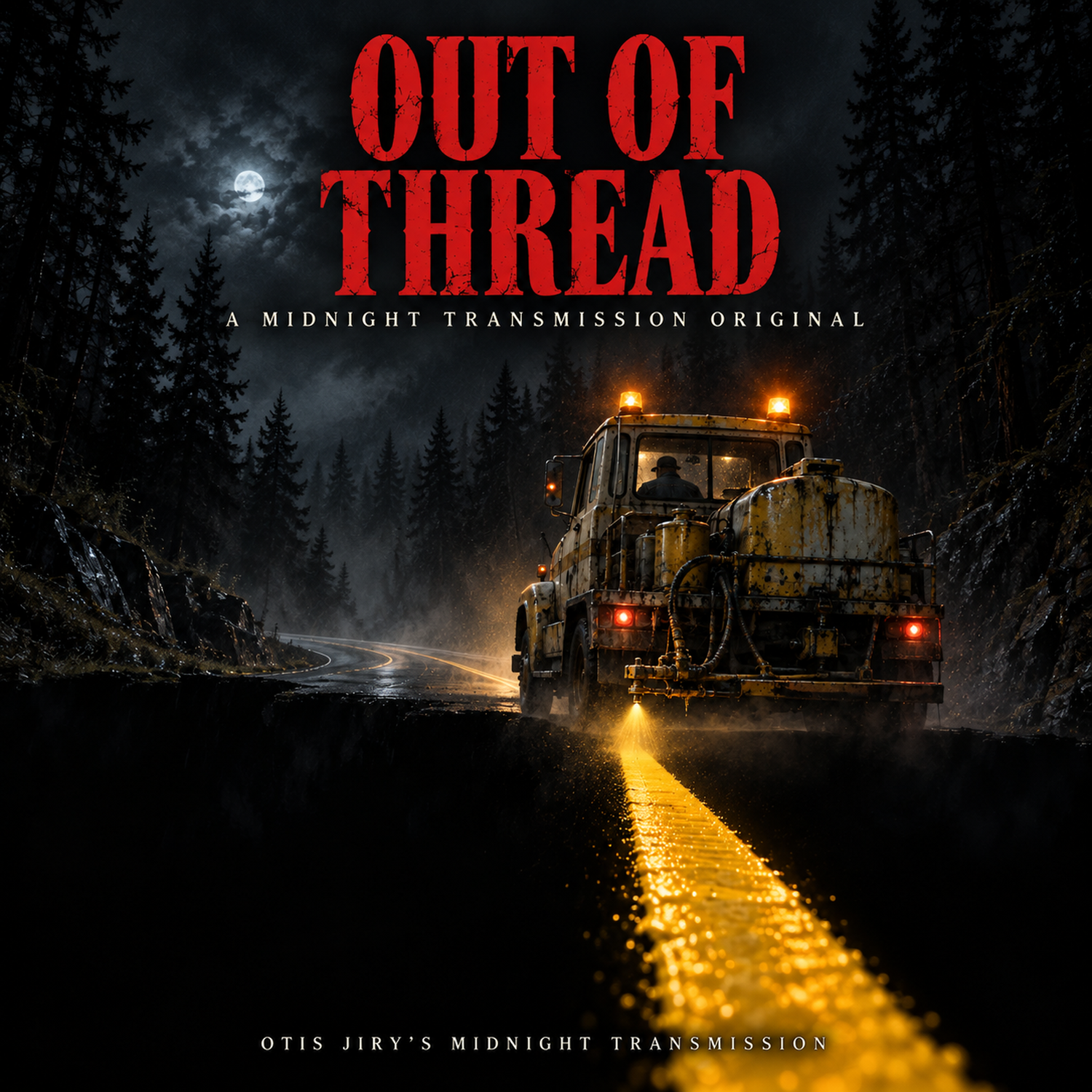
I throw the truck into gear. The heavy diesel engine roars, a low-frequency rumble that vibrates through the metal floorboards and directly into the soles of my work boots. I flip the switches on the dash console. The air compressor behind my head begins to chug, its rhythmic, heavy iron heartbeat filling the small cabin. *Chug-hiss, chug-hiss.* With a wet pop, the rear nozzles engage, spraying the thick, sulfurous Formula-9 onto the center of Route 99.
Almost immediately, the truck's dashboard begins to act strange. The GPS unit, a rugged military-grade model bolted to the console, starts to flicker. The digital map doesn't show the straight path of the highway anymore; instead, the little blue triangle representing my truck begins to spin in frantic, dizzying circles, its compass needle wandering like a blind dog in an alley. I tap the glass, but the screen only blurs with static. I lean forward, squinting through the dirt-streaked windshield into the absolute darkness of the forest flanking the road. The pine trees look stiff, frozen, as if they aren't wood at all but dark metal spikes driven into the earth.
To check my progress, I glance at the rearview camera monitor mounted near the ceiling. The screen displays a high-resolution feed of the road directly behind the rear bumper. My stomach drops, a cold, empty sensation like a transmission failing at sixty miles per hour. The wet yellow line is glowing on the screen, a brilliant, bioluminescent stripe cutting through the dark. But beyond that line—where the unpainted asphalt should be—there is nothing. It isn't just dark. The road behind me is gone. The screen shows an absolute, physical, ink-black void, a bottomless vacuum where the earth itself has simply ceased to exist. Where the glowing paint hasn't settled, the world is gone.
My hand starts to shake, the skin on my palms turning clammy and slick against the hard plastic steering wheel. I try to convince myself it’s a camera glitch, a lens coated in road grime or a loose wire in the monitor's housing. I reach out and turn on the truck’s AM radio, hoping for a local weather report or even just the comforting static of a distant station. Instead, the speaker crackles to life with the harsh, mechanical tone of a local emergency broadcast. A flat, synthesized voice speaks through the static: *"Seismic warning. A localized tectonic event of magnitude 2.1 has been recorded at coordinates forty-four point nine, negative one hundred and twenty. Residents are advised to seek shelter."*
Those coordinates are mine. Before I can process the announcement, my foot slips slightly on the accelerator, and the truck's speed drops from six miles per hour down to four. Instantly, the radio cuts out into a deafening, high-pitched squeal. The truck shudders. It’s not a normal vibration; it's a violent, metal-shattering bucking that starts deep in the chassis. The steering wheel jerks violently in my grip, nearly wrenching my wrists out of joint. The dashboard rattles, the glove box pops open, and Sarah’s postcard flutters to the floorboards. The road beneath my tires feels like it’s being kicked from below by a massive, angry boot.
I slam my foot down on the gas pedal. The engine screams, the RPMs spike, and the speedometer needle climbs back up to six miles per hour. As soon as the needle crosses the five-mile-per-hour mark, the shaking stops. The silence that returns is heavy, broken only by the steady *chug-hiss* of the paint compressor. The radio crackles back to life, the synthetic voice returning in a calm, flat tone: *"Tectonic event has subsided. The region is currently stable."* An oily sweat of panic mixes with the diesel grime on my face, but I force myself to keep my foot locked on the accelerator. I can't slow down. If I drop below five miles per hour, whatever is underneath this asphalt is going to shake me to pieces.
The headlights cut through the heavy, stagnant air, illuminating the next stretch of Route 99. The forest on either side of the road isn't quiet anymore. The pine needles are rustling, but there is no wind. Then, I see them. They crawl out from the shadow of the metal-stiff trees, slipping onto the shoulder of the highway. They aren't creatures of flesh and blood. Their bodies are made of grinding, shifting plates of dark shale and calcified, mineralized bone. They move on six or eight jointed limbs that pop and crack like dry branches in a fire, their joints clicking with a wet, stony sound. Their heads are flat, featureless slabs of rock, save for a wide, jagged horizontal split that opens to reveal rows of needle-sharp, black crystalline teeth.
They don't look at the truck. They don't look at me. Instead, they swarm toward the fresh, glowing stripe of Formula-9 behind the rear bumper. I watch the rear monitor, my eyes wide, the sweat of panic dripping into my eyes. The shale-skinned things drop their heavy heads to the asphalt, their crystalline teeth scraping against the road with a horrific, metallic screech that vibrates right through the truck's frame. They are licking the wet paint. They are devouring the glowing yellow compound, their stony bodies shuddering with a strange, hungry ecstasy. But they cannot cross it. One of the larger creatures, its back covered in jagged ridges of slate, tries to step over the freshly painted line to reach the other side of the road. The moment its stony limb touches the glowing stripe, a thick plume of sulfurous steam hisses upward. The creature recoils, its shale joints popping violently as if scorched by an invisible, high-voltage current. It lets out a dry, rattling hiss—a sound like grinding stones—and retreats into the dark, unable to bypass the barrier.
My breath is coming in short, ragged gasps. I grab the heavy, plastic microphone of the two-way radio, my fingers slick with sweat. I squeeze the talk button. "Dispatch! Dispatch, this is Unit Seven on Route 99! Do you copy? I’ve got... there are things on the road. The asphalt behind me is dissolving into nothing. I need an emergency extraction. I need a crew out here now!" There is a long pause of dead air, then a burst of static, and then the dispatcher's voice comes through the speaker. It’s perfectly calm, flat, and slow. *"Unit Seven, this is Dispatch. Maintain a steady application of Formula-9. Do not allow your speed to drop below five miles per hour. Your service is essential to the safety of the corridor. Keep the line straight."*
"You don't understand!" I yell into the mic, my voice cracking with desperation. "The road is gone! The trees are vibrating! I'm running out of paint, and these... these stone things are eating it! Send someone!" The speaker clicks. *"Unit Seven, this is Dispatch. Maintain a steady application of Formula-9. Do not allow your speed to drop below five miles per hour. Your service is essential to the safety of the corridor. Keep the line straight."* It’s the exact same cadence. The exact same slight pop of static at the third second. The same sterile, mechanical rhythm. My stomach drops, a sickening weight in my gut. It’s a loop. An automated broadcast designed to sound like a live dispatcher, keeping me moving forward while nobody is actually listening on the other end.
I look down at the GPS unit. The screen has finally stopped spinning, but the map has zoomed out to an impossible scale. The straight line of Route 99 is gone. On the digital screen, the path I am painting is curving, winding back on itself in tight, concentric circles, forming a massive, geometric pattern that covers the entire state. It isn't a highway. It's a drawing. A giant, looping symbol being traced onto the crust of the earth, and my truck is the pen.
The road begins to tilt upward. I look through the windshield, and my jaw goes slack. The asphalt doesn't just climb a hill; it rises in a steep, near-vertical wall that defies gravity. The diesel engine screams in protest, the transmission grinding as it struggles to find a gear that can handle this impossible incline. The speedometer needle begins to drift backward. Five miles per hour. Four. Three. "No, no, no," I mutter, slamming my chest against the steering wheel as if I could push the ten-ton truck up the slope myself. "Don't you stall on me. Don't you dare stall."
The radio doesn't just squeal this time; it explodes with a wall of white noise, followed by a sound that makes my teeth ache. It’s a deep, rhythmic, low-frequency thrum that rises from the earth below. *Thump-thump.* The truck doesn't shake; the road beneath the tires begins to buckle and roll in slow, heavy waves, rising and falling like the chest of a sleeping giant. The asphalt is soft now, stretching and warping under the weight of the tires. *Thump-thump.* The sound isn't seismic static. It’s a heartbeat. A colossal, planetary pulse vibrating through the metal frame, through the seat, through my bones. Every time the earth beats, the road lifts, and the trees on the hillsides tilt like grass in a storm. The speed drops to two miles per hour. The engine is choking, black smoke pouring from the stack, the air compressor screaming a high-pitched, dying whine as the truck tries to crawl up the back of whatever is breathing beneath us.
Suddenly, the high-pressure compressor behind my head stops chugging. It lets out a long, wheezing sigh, followed by a sharp, metallic *ping*. On the dashboard, the paint pressure gauge drops. Ten percent. Five. Zero. The wet *hiss-splat* of the nozzles stops. Through the rearview monitor, I see the glowing yellow line taper off into a thin, watery streak, and then... nothing. Only the dry, gray asphalt of the unpainted road.
My hand falls from the gear shift. The pieces don’t fit together like a puzzle; they collide like a head-on wreck. The sulfur. The salt. The heavy, pressurized tires tracing this exact, impossible geometry year after year. It wasn't road maintenance. It was a seal. A physical boundary laid down to bind the kinetic energy of the shifting plates below. The salt to preserve, the sulfur to burn away the things that crawl from the cracks. Route 99 isn't a highway. It's a continuous, continental suture stitched into the skin of the earth to keep whatever is breathing beneath from breaking through. And I have just run out of thread.
The silence that follows is more terrifying than the roar of the engine. For a second, the world seems to hold its breath. Then, the tearing begins. Behind the truck, where the wet yellow paint ran dry, the seal fails. The asphalt splits down the middle with a sound like an iron plate snapping in half, a deafening crack that echoes through the dead forest. The road doesn't just crack; it peels backward, the earth folding open like paper being torn by giant, invisible hands. The bottomless, ink-black void rushes forward, swallowing the unpainted highway, the trees, the hillsides, devouring everything in its path.
With the yellow barrier gone, the shale-skinned creatures don't recoil. They surge forward in a frantic, clicking wave, their stone joints grinding in a frenzy of hunger. They swarm the truck, their heavy, rocky bodies slamming against the metal cab. I hear the screech of their crystalline teeth gnawing through the steel doors, the windshield shattering into a spiderweb of cracks as a heavy, slate-covered limb punches through the glass. I don't scream. My throat is too dry, my breath caught in my chest like a physical block. I reach down and pick up Sarah’s postcard from the floorboards, my thumb tracing her jagged handwriting through the layer of grease and sweat.
The forest on either side of the road begins to slide away, tilting into the expanding chasm. But they aren't falling. The hillsides are folding outward, revealing what lies beneath the thin, fragile crust of soil and stone we call the earth. Through the shattered windshield, I see them. Underneath the roots of the pine trees, embedded in the deep, dark layers of the continental plate, are billions of glowing, milky-white eyes. They are blind, ancient, and colossal, each one the size of a city block, blinking slowly as the light of the night sky hits them for the first time in millions of years. The earth beneath my truck isn't rock anymore. It is a vast, shifting mass of pale, ribbed flesh, rising from the deep, shaking off the weight of the mountains like dust.
The truck's front wheels slip off the crumbling edge of the asphalt. The nose of the heavy International Harvester tilts downward, pointing into the bottomless, silent void. I clutch the postcard tight against my chest, feeling the cold air of the abyss rushing up to meet me. I think of Sarah, of her wedding, of the life I missed while I was out here, night after night, keeping the lines straight. I used to think my job was mundane. I used to think I was just a ghost on the highway, a forgotten man doing forgotten labor. But as the truck slips into the dark, and the world-ending god beneath the crust opens its mouth to swallow the sky, I realize the terrifying truth. I was the only thing keeping the world together. And tonight, I didn't finish the line.